Just read Campbell McGrath's 2004 collection, Pax Atomica. Holy crap, that was a fun read -- not usually one's first reaction to a book of poetry, eh? I read his Florida Poems a couple of years ago and appreciated it, but I wasn't right there with it, because I've never set foot in the state of Florida. But Pax Atomica is all about growing up in a world of seventies rock, where you love Springsteen and Led Zeppelin and you don't let on that you kinda like Ted Nugent, where you watch Tom Snyder and the late late show before the TV station plays the National Anthem and goes off the air, where the world is full of the tacky crazy things that people make and yet "We build the human heart / and lock it in its chest / and hope that what we have made can save us." And in the end, even though everyone knows John Lennon is dead, there's still a kind of salvation we can find while listening to Guns'n'Roses and grieving for our own personal dead. I recognize so much in these poems and I felt myself nodding my head and (metaphorically speaking) slapping my steering wheel & singing along.
I got this one out of the library, but it's going on the "buy me" list -- and now I am really looking forward to his reading Thursday night.
Monday, February 27, 2006

Sunday, February 26, 2006
Resurrection of the Trusty Steed
Got my car back Friday. Finally! At the risk of overstating it a bit, it feels like being back in my own body again. Not quite "good as new" but I think the body shop did a decent job. Celebrated with a couple of new CDs: Rosanne Cash's Black Cadillac (brilliant, powerful songwriting) and K.T. Tunstall's Eye to the Telescope (quite nice).
J.D. McClatchy (who looks just like his photograph, except that he wears glasses to read) gave a reading on campus today. I hadn't heard him read before; he was quite good. He was here in the first place -- and has been in town for a couple of weeks or so -- because IU's Jacobs School of Music was hosting the premiere of the Our Town opera, for which Ned Rorem wrote the music and McClatchy wrote the libretto. He opened the reading by speaking for a minute about the differences between writing poetry & writing libretti; when you write a libretto you are aiming for simplicity and clarity, whereas "Poetry, on the other hand, is meant to complicate things, not simplify things."
This is interesting to me because, yes, complexity does seem to be one of the criteria for poetry; but at the same time poetry requires an economy of language, and poetic language provides a certain directness, a language that hews more closely to actual sense-experience -- it's like a more faithful translation of the untranslatable, if that makes any sense at all. So really, poetry simplifies by complicating -- or complicates by simplifying, depending on which end of the telescope you choose to look through. Poetry doesn't (or shouldn't, anyway) use complexity for the purpose of sheer obfuscation; it complicates in order to make the familiar strange, to make the reader see it new and in that novelty to see it more clearly illumined. Complexity in the name, not of confusion, but of the kind of clarity you can only get when you've got to give it your full attention and work for it a bit.
I think of Adrienne Rich's poem "Planetarium," a poem which has been a touchstone for me for many years. It ends like this:
Anyway, McClatchy's reading obviously made me think, which is always a good thing. :) He read several poems from Hazmat along with some others, including "My Mammogram" (which for some reason struck me today as parallelling Mark Doty's "Heaven for Paul" closely in some ways -- I'll have to go back & give the two a side-by-side reading, but the way they juxtapose the comic, the frightening, & the profound in a narrative context seems similar). Oh, and during the brief Q&A afterwards someone asked about his writing process; he said that he tries to carry poems around in his head as long as possible because once you write them down you fall in love with them, & then he works on them for a fairly long time. I envy poets who can carry poems around in their heads like that; I find that if I don't jot down at least something, I lose track of it. I mean, I'll sometimes chew on a few lines inside my head for an hour or two, but that's about it. Perhaps the remembery part of my brain is broken. Or dented, at least.
EDIT: Here's a brief write-up of McClatchy's reading from the Indiana Daily Student.
J.D. McClatchy (who looks just like his photograph, except that he wears glasses to read) gave a reading on campus today. I hadn't heard him read before; he was quite good. He was here in the first place -- and has been in town for a couple of weeks or so -- because IU's Jacobs School of Music was hosting the premiere of the Our Town opera, for which Ned Rorem wrote the music and McClatchy wrote the libretto. He opened the reading by speaking for a minute about the differences between writing poetry & writing libretti; when you write a libretto you are aiming for simplicity and clarity, whereas "Poetry, on the other hand, is meant to complicate things, not simplify things."
This is interesting to me because, yes, complexity does seem to be one of the criteria for poetry; but at the same time poetry requires an economy of language, and poetic language provides a certain directness, a language that hews more closely to actual sense-experience -- it's like a more faithful translation of the untranslatable, if that makes any sense at all. So really, poetry simplifies by complicating -- or complicates by simplifying, depending on which end of the telescope you choose to look through. Poetry doesn't (or shouldn't, anyway) use complexity for the purpose of sheer obfuscation; it complicates in order to make the familiar strange, to make the reader see it new and in that novelty to see it more clearly illumined. Complexity in the name, not of confusion, but of the kind of clarity you can only get when you've got to give it your full attention and work for it a bit.
I think of Adrienne Rich's poem "Planetarium," a poem which has been a touchstone for me for many years. It ends like this:
I have always thought that "the most accurately transmitted most / untranslateable language in the universe" was as close to a definition of poetry as I was ever going to see.I have been standing all my life in the
direct path of a battery of signals
the most accurately transmitted most
untranslateable language in the universe
I am a galactic cloud so deep so invo-
luted that a light wave could take 15
years to travel through me And has
taken     I am an instrument in the shape
of a woman trying to translate pulsations
into images     for the relief of the body
and the reconstruction of the mind.
Anyway, McClatchy's reading obviously made me think, which is always a good thing. :) He read several poems from Hazmat along with some others, including "My Mammogram" (which for some reason struck me today as parallelling Mark Doty's "Heaven for Paul" closely in some ways -- I'll have to go back & give the two a side-by-side reading, but the way they juxtapose the comic, the frightening, & the profound in a narrative context seems similar). Oh, and during the brief Q&A afterwards someone asked about his writing process; he said that he tries to carry poems around in his head as long as possible because once you write them down you fall in love with them, & then he works on them for a fairly long time. I envy poets who can carry poems around in their heads like that; I find that if I don't jot down at least something, I lose track of it. I mean, I'll sometimes chew on a few lines inside my head for an hour or two, but that's about it. Perhaps the remembery part of my brain is broken. Or dented, at least.
EDIT: Here's a brief write-up of McClatchy's reading from the Indiana Daily Student.
Thursday, February 23, 2006
Upcoming events
Sunday afternoon on campus, J.D. McClatchy will be reading. He's in town for the world premiere of the Our Town opera, for which he wrote the libretto & Ned Rorem (who's here as well) wrote the music. Yep, Our Town as in Thornton Wilder. I probably won't make it to the opera, but do plan to get to the poetry reading. I have to admit I haven't read that much of McClatchy's work, but have liked what I've read.
Thursday evening of next week is a hot double bill at the John Waldron Arts Center downtown: Marianne Boruch and Campbell McGrath. Both are poets I read for the first time when I took a class with Cathy Bowman a couple years ago; McGrath's Florida Poems was one of the books read & discussed by the whole class, and I enjoyed it a great deal.
Next month (March 24, to be exact) Five Women Poets, my poetry group, will be reading at the Runcible Spoon in celebration of Women's History Month. No idea yet what I'll be reading, but readings at the Spoon are always fun. It's a local coffeehouse/restaurant that's been around since the late seventies, which qualifies it as a Bloomington institution; it's known for excellent coffee, less-than-lightning-fast service, and the fish living in the bathtub in its bathroom. The bathroom was actually featured on the Travel Channel once, some show about the "ten coolest bathrooms in America" or something. The owner and chef, Matt O'Neill, is a poet and very supportive of Bloomington's poetry community. Plus, they have the best brunch in town -- wonderful omelets and perfect bacon.
I am supposed to be getting my car back tomorrow -- yes, more than three weeks after the accident. It's been fun driving the rental (a brand-new 2006 PT Cruiser, not the car I'd pick out to buy for myself, but always fun to drive something shiny and new) but it will be good to be back in my own little Corolla again.
Tonight is all about the skating -- Olympic ladies' finals. I've been assiduously avoiding spoilers all day. Not sure whether I'm cheering for Sasha Cohen or Irina Slutskaya; I just hope both of them (and heck, everyone else too) skate their best. I love watching ice skating. Someday I'm sure it will turn up in a poem.
Thursday evening of next week is a hot double bill at the John Waldron Arts Center downtown: Marianne Boruch and Campbell McGrath. Both are poets I read for the first time when I took a class with Cathy Bowman a couple years ago; McGrath's Florida Poems was one of the books read & discussed by the whole class, and I enjoyed it a great deal.
Next month (March 24, to be exact) Five Women Poets, my poetry group, will be reading at the Runcible Spoon in celebration of Women's History Month. No idea yet what I'll be reading, but readings at the Spoon are always fun. It's a local coffeehouse/restaurant that's been around since the late seventies, which qualifies it as a Bloomington institution; it's known for excellent coffee, less-than-lightning-fast service, and the fish living in the bathtub in its bathroom. The bathroom was actually featured on the Travel Channel once, some show about the "ten coolest bathrooms in America" or something. The owner and chef, Matt O'Neill, is a poet and very supportive of Bloomington's poetry community. Plus, they have the best brunch in town -- wonderful omelets and perfect bacon.
I am supposed to be getting my car back tomorrow -- yes, more than three weeks after the accident. It's been fun driving the rental (a brand-new 2006 PT Cruiser, not the car I'd pick out to buy for myself, but always fun to drive something shiny and new) but it will be good to be back in my own little Corolla again.
Tonight is all about the skating -- Olympic ladies' finals. I've been assiduously avoiding spoilers all day. Not sure whether I'm cheering for Sasha Cohen or Irina Slutskaya; I just hope both of them (and heck, everyone else too) skate their best. I love watching ice skating. Someday I'm sure it will turn up in a poem.
Monday, February 20, 2006
What I do on my summer vacation
So I'm reading through the current issue of Poets & Writers, and noticing that there are approximately six bajillion ads for various summer programs -- conferences, workshops, pretty much any variation on that theme you can imagine. Conferences where you go and listen to other people talk and schmooze with agents and editors. Workshops at universities and in resort towns. Summer programs where you take what you've already written and go to get it critiqued, and summer programs where you go and write a whole bunch of new stuff. Places where you have to apply to get in and places that will let anybody in so long as they shell out the money. And I'm looking at all these ads and I'm thinking, man, what a racket.
Now, I love summer workshops. I've been to the Indiana U. Writers' Conference, the Iowa Summer Writing Festival, the Split Rock Arts Program in Minnesota, and the Fine Arts Work Center summer program in Provincetown -- and I've had a great time at all of them. I've worked with some terrific teachers: Carolyn Kizer, Lucia Perillo, Michael Carey, Kate Green, Cleopatra Mathis, D.A. Powell, and others. I get a little something different out of each workshop I attend, too. When I took a workshop with Carolyn Kizer at the IU conference, back in 1981 (I think) when I was twenty, just being taken seriously as a poet and having my work discussed was a trip and a half -- not to mention the readings every evening; it was the first time I'd been immersed in poetry for a week like that, and it felt amazing. I remember that Kizer used one of the poems from my manuscript as a jumping-off point for a discussion of whether political poetry could be good poetry or whether the politics inherently compromised the art -- because that was a topic I cared about pretty intensely, I was thrilled that my little poem sparked off the discussion.
But you know, there is this stereotype of the middle-aged, usually female, usually crappy poet who attends these summer workshops & conferences, collecting t-shirts and names of famous poets she has worked with along the way. And it kind of scares me to think I might be That Person. God knows nobody at these summer programs is going to disillusion someone by telling them they're a crappy poet; they want to encourage you , keep you coming back and paying money. These programs are huge cash cows in many cases, I'm sure. (Then again, why tell someone they're a crappy poet if writing poetry makes them happy, makes their life better? Just don't encourage them to send out their work for publication, spare the poor editors, but writing crappy poetry is not the worst hobby a person could have.)
Now, I don't (usually) think I am That Person. I take my work seriously (too seriously, sometimes). I read a lot of poetry, which often seems to be how you can distinguish a middle-aged-lady-crappy-poet from a "Real" (oh, there' s a dangerous word) poet. I get published here and there, which I take to be a possible sign of non-craptastic-ness. But still, as I shell out my hard-earned cash for workshops and prepare to make my middle-aged way across the country yet again, I wonder about these things sometimes.
Anyway, that's neither here nor there, nor is it the post I started out intending to make. I've been thinking about my various summer-workshop experiences, and about what makes a good summer workshop, and how that's different from what makes a good, say, MFA workshop. (Not that I've been in an MFA workshop, but I've been in plenty of undergrad workshops, and a grad-level workshop that was full of MFA fiction students, etc.) Part of it is, of course, the immersion factor. There's a big difference for me in attending the IU conference, where I come home for dinner most days and come home at night and my regular life sort of intrudes a bit, versus going out of town -- but even attending the IU conference is a bit of an immersive experience. When it's good, it's intense; when it's not as good, it's just exhausting. I have had the experience of being so fully immersed in poetry that every slant of light, every blast of the foghorn on the Long Point lighthouse, every walk up that one steep hill in Iowa City makes my skin feel like it's about to burst with poems. Images start falling into lines inside my head without me even consciously manipulating them. It's an amazing feeling. I don't know if I could bear to live that way 24/7 for more than a few days at a time, but for those few days, it's pretty incredible.
The workshop itself, I think, has to be different for a short one-week experience than for a semester-long class or a multiple-year program. You've got a bunch of people who have probably never met one another before and very possibly will never see each other again after the week is over; creating an atmosphere of intimacy and trust has got to be the first order of business. Depending on the workshop, you may have a pretty wide range of experience levels; you may have people with MFA's sitting at the same table with people who've never been in a workshop before. That can make things rocky, or it can create all kinds of interesting tensions and energies. At its best, I think a summer workshop can be like a great one-night stand (not that I'm an expert there!) -- you go immediately to this intense level of intimacy, and you sort of have less to lose by exposing yourself because you have the safety of walking away when it's over. Or the illusion of safety, anyway.
I think the summer workshops that work best are the ones that are structured around a particular aspect of writing, or a particular theme, or have some sort of focus besides just "okay, we're gonna workshop everybody's poems for a week." Which doesn't mean you're not going to explore other topics or aspects (D.A. Powell's workshop last summer was ostensibly focused on revision, but goodness knows we talked about a lot of other things besides), and which doesn't mean a non-thematic workshop won't sort of organically develop its own flavor and focus as themes and topics arise from the poems and the poets in the room. (The way Lucia Perillo continually returned to the idea of mystery, for example.)
And as a student coming into a summer workshop, I think they work best when you think ahead of time about what you want to get out of the workshop, focus your energy somehow. You can't cover everything you need or want to learn about poetry in one short week, but maybe you can come away with three ideas about how to approach revision, or with information about several new places to submit your work, or having made a decision about whether you want to try applying to MFA programs, or with a notion about how to go about structuring a chapbook manuscript, or with ideas about how to discipline yourself to write every day. Or you can just go and try to be as emotionally & artistically open as possible and try to keep yourself in that open, intimate frame of mind for as much of the week as you can stand it.
I'm going to think more about what makes a good summer workshop -- I haven't yet talked about what makes someone a good summer-workshop teacher, which is another issue entirely, or about the stuff that happens in these programs other than actual workshops -- and maybe blog about this some more in the next couple of days. But I'd be interested to hear thoughts on summer workshops & conferences in general, from people who have attended them & people who have taught at them -- and maybe from people who don't want to attend them, too; I'm certainly open to the "these programs just want to take your money" point of view, even if it's in my best interest to disagree vehemently. *grin* So: thoughts?
Now, I love summer workshops. I've been to the Indiana U. Writers' Conference, the Iowa Summer Writing Festival, the Split Rock Arts Program in Minnesota, and the Fine Arts Work Center summer program in Provincetown -- and I've had a great time at all of them. I've worked with some terrific teachers: Carolyn Kizer, Lucia Perillo, Michael Carey, Kate Green, Cleopatra Mathis, D.A. Powell, and others. I get a little something different out of each workshop I attend, too. When I took a workshop with Carolyn Kizer at the IU conference, back in 1981 (I think) when I was twenty, just being taken seriously as a poet and having my work discussed was a trip and a half -- not to mention the readings every evening; it was the first time I'd been immersed in poetry for a week like that, and it felt amazing. I remember that Kizer used one of the poems from my manuscript as a jumping-off point for a discussion of whether political poetry could be good poetry or whether the politics inherently compromised the art -- because that was a topic I cared about pretty intensely, I was thrilled that my little poem sparked off the discussion.
But you know, there is this stereotype of the middle-aged, usually female, usually crappy poet who attends these summer workshops & conferences, collecting t-shirts and names of famous poets she has worked with along the way. And it kind of scares me to think I might be That Person. God knows nobody at these summer programs is going to disillusion someone by telling them they're a crappy poet; they want to encourage you , keep you coming back and paying money. These programs are huge cash cows in many cases, I'm sure. (Then again, why tell someone they're a crappy poet if writing poetry makes them happy, makes their life better? Just don't encourage them to send out their work for publication, spare the poor editors, but writing crappy poetry is not the worst hobby a person could have.)
Now, I don't (usually) think I am That Person. I take my work seriously (too seriously, sometimes). I read a lot of poetry, which often seems to be how you can distinguish a middle-aged-lady-crappy-poet from a "Real" (oh, there' s a dangerous word) poet. I get published here and there, which I take to be a possible sign of non-craptastic-ness. But still, as I shell out my hard-earned cash for workshops and prepare to make my middle-aged way across the country yet again, I wonder about these things sometimes.
Anyway, that's neither here nor there, nor is it the post I started out intending to make. I've been thinking about my various summer-workshop experiences, and about what makes a good summer workshop, and how that's different from what makes a good, say, MFA workshop. (Not that I've been in an MFA workshop, but I've been in plenty of undergrad workshops, and a grad-level workshop that was full of MFA fiction students, etc.) Part of it is, of course, the immersion factor. There's a big difference for me in attending the IU conference, where I come home for dinner most days and come home at night and my regular life sort of intrudes a bit, versus going out of town -- but even attending the IU conference is a bit of an immersive experience. When it's good, it's intense; when it's not as good, it's just exhausting. I have had the experience of being so fully immersed in poetry that every slant of light, every blast of the foghorn on the Long Point lighthouse, every walk up that one steep hill in Iowa City makes my skin feel like it's about to burst with poems. Images start falling into lines inside my head without me even consciously manipulating them. It's an amazing feeling. I don't know if I could bear to live that way 24/7 for more than a few days at a time, but for those few days, it's pretty incredible.
The workshop itself, I think, has to be different for a short one-week experience than for a semester-long class or a multiple-year program. You've got a bunch of people who have probably never met one another before and very possibly will never see each other again after the week is over; creating an atmosphere of intimacy and trust has got to be the first order of business. Depending on the workshop, you may have a pretty wide range of experience levels; you may have people with MFA's sitting at the same table with people who've never been in a workshop before. That can make things rocky, or it can create all kinds of interesting tensions and energies. At its best, I think a summer workshop can be like a great one-night stand (not that I'm an expert there!) -- you go immediately to this intense level of intimacy, and you sort of have less to lose by exposing yourself because you have the safety of walking away when it's over. Or the illusion of safety, anyway.
I think the summer workshops that work best are the ones that are structured around a particular aspect of writing, or a particular theme, or have some sort of focus besides just "okay, we're gonna workshop everybody's poems for a week." Which doesn't mean you're not going to explore other topics or aspects (D.A. Powell's workshop last summer was ostensibly focused on revision, but goodness knows we talked about a lot of other things besides), and which doesn't mean a non-thematic workshop won't sort of organically develop its own flavor and focus as themes and topics arise from the poems and the poets in the room. (The way Lucia Perillo continually returned to the idea of mystery, for example.)
And as a student coming into a summer workshop, I think they work best when you think ahead of time about what you want to get out of the workshop, focus your energy somehow. You can't cover everything you need or want to learn about poetry in one short week, but maybe you can come away with three ideas about how to approach revision, or with information about several new places to submit your work, or having made a decision about whether you want to try applying to MFA programs, or with a notion about how to go about structuring a chapbook manuscript, or with ideas about how to discipline yourself to write every day. Or you can just go and try to be as emotionally & artistically open as possible and try to keep yourself in that open, intimate frame of mind for as much of the week as you can stand it.
I'm going to think more about what makes a good summer workshop -- I haven't yet talked about what makes someone a good summer-workshop teacher, which is another issue entirely, or about the stuff that happens in these programs other than actual workshops -- and maybe blog about this some more in the next couple of days. But I'd be interested to hear thoughts on summer workshops & conferences in general, from people who have attended them & people who have taught at them -- and maybe from people who don't want to attend them, too; I'm certainly open to the "these programs just want to take your money" point of view, even if it's in my best interest to disagree vehemently. *grin* So: thoughts?
Saturday, February 18, 2006
Luck
 Major props to Lucia Perillo, who just won the Kingsley Tufts Poetry Award ($100,000). I may have mentioned before that I took a workshop with her at the Indiana U. Writers' Conference a few years back -- in 2002, I think -- and enjoyed her a great deal. She kept talking about mystery, and wanting poems to have some mystery in them; I think this was exactly what I needed to hear at the time. Certainly it's one way to start looking at a poem, whether someone else's that you're trying to understand or your own that you're trying to revise: where is the mystery in this poem? how does the poem embrace or try to escape its own mystery?
Anyway, I'm tickled that she has won this award. Her new(ish) book, Luck is Luck, is worth a read (as are her others).
EDITED TO ADD: Here is David Kirby's review of Luck is Luck, from the New York Times.
Locally, all I can say is that it's damned cold. I know you people in Minnesota and environs have it colder, but I stayed in my warm bed (heated mattress pad, flannel sheets, down comforter, another comforter, and two warm cats) as long as I could stand it this morning, and it was still only 10 degrees outside when I got up. Now (almost 9 pm) it's back down to 10 again, though with lots of bright sunshine it wasn't too ungodly awful this afternoon at around 16 degrees. I ran around town a bit doing some retail therapy today (FOUR new pairs of socks!); had brunch at the Runcible Spoon, where I spent some time writing in my journal outlining a manuscript I want to put together -- taking a long-ass poem I'm having trouble working with as a cohesive whole and breaking it into fragments, which will be interpolated with other related and semi-unrelated poems. Could be interesting, I think.
But now I'm in for the evening, in my house which although cold and drafty is at least warmer than it is outside. I've got a heated throw blanket and a down throw blanket over me here on the couch, along with a very large fluffy cat on my lap who pretty much serves as a throw blanket all by himself, and a hat on my head (yes, inside the house -- it's cold in here, and my heating bills have been painful this winter so I'm not turning that thing up past 58). I've got the Olympics on TV, and a couple of books & journals close at hand, in addition to this laptop. I've been reading Floyd Skloot's memoir, In the Shadow of Memory, which includes some interesting meditations on personal/family history, brain injury (he suffered a viral infection of the brain that left him quite neurologically disabled), the nature of memory, the nature of self, and the way all of that influences language. It's quite a fascinating book. I'm not terribly familiar with his poetry, but after reading this book I think I will find some of that and read it.
Stay warm, y'all.
Thursday, February 16, 2006
Summer in Iowa
The Iowa Summer Writing Festival has posted its schedule of workshops for this summer. I've been there three times, if I recall correctly; once I did a week-long workshop, once I did a weekend followed by a week, and once I drove out there just for a quick weekend workshop. Had a great time every time, working with fabulous teachers like Meredith Stricker, Michael Carey, and Kathleen Peirce. Michael Carey was a particularly terrific teacher; the workshop I had with him included students at all levels, from real beginners to published poets, and he managed to pull us all together so that we were all challenged & all learning from one another. He's not a particularly well-known poet, but he is a good teacher & a very sweet guy.
I haven't been to ISWF since the early nineties, and I won't be going this year, since (unless something happens to screw it up financially) I'm going to Provincetown and can't afford to do two. But if you're looking for a nice workshop and don't object to spending a week in Iowa City, I highly recommend this program. (And hey, Iowa City is nice. Plus they have Prairie Lights, which is one of the nicer bookstores I've spent time in, and as I recall the used bookstores are quite good too.)
Here's a poem:
Amen
for Kelly
See the day lilies at the edge
of our field, how we walk through them
every spring and talk of the things
we will do when our lives allow
and the children are blooming.
And the field itself,
no matter how we abuse it,
it loves us and feeds us
and asks us to return.
Every year we bend our backs
over the crop, over the weeds,
over the tenderly buzzing insects.
It hurts so much and is never enough.
See how often we cry
over nothing, over each other,
our children, our small wants
and needs; how hungry we stay
and how long is eternity.
See how your limbs and mine
find each other, again
and again, that same door
always opening, how sweetly
we sing the older we get.
Soon we will
have lived with each other
longer than we have lived
with ourselves and more easily.
There is a lesson in this
and love. Consider it.
---Michael Carey
from Honest Effort (Duluth, MN: Holy Cow! Press, 1991)
I haven't been to ISWF since the early nineties, and I won't be going this year, since (unless something happens to screw it up financially) I'm going to Provincetown and can't afford to do two. But if you're looking for a nice workshop and don't object to spending a week in Iowa City, I highly recommend this program. (And hey, Iowa City is nice. Plus they have Prairie Lights, which is one of the nicer bookstores I've spent time in, and as I recall the used bookstores are quite good too.)
Here's a poem:
Amen
for Kelly
See the day lilies at the edge
of our field, how we walk through them
every spring and talk of the things
we will do when our lives allow
and the children are blooming.
And the field itself,
no matter how we abuse it,
it loves us and feeds us
and asks us to return.
Every year we bend our backs
over the crop, over the weeds,
over the tenderly buzzing insects.
It hurts so much and is never enough.
See how often we cry
over nothing, over each other,
our children, our small wants
and needs; how hungry we stay
and how long is eternity.
See how your limbs and mine
find each other, again
and again, that same door
always opening, how sweetly
we sing the older we get.
Soon we will
have lived with each other
longer than we have lived
with ourselves and more easily.
There is a lesson in this
and love. Consider it.
---Michael Carey
from Honest Effort (Duluth, MN: Holy Cow! Press, 1991)
Monday, February 13, 2006
All dressed up and nowhere to go
Took the afternoon off work and spent a few hours at my desk revising a chapbook ms. until it felt reasonably good to me. Now I'm suddenly finding that most chapbook contests either had deadlines back in December or don't close until at least May or so.
Anyone know of any good chapbook contests (other than Tupelo Press) with a deadline between now and, say, April? I'm sure I will hate this ms. again in a few weeks, so I should shoot it out to as many places as I can while I can still stand it. ;)
Anyone know of any good chapbook contests (other than Tupelo Press) with a deadline between now and, say, April? I'm sure I will hate this ms. again in a few weeks, so I should shoot it out to as many places as I can while I can still stand it. ;)
Thursday, February 09, 2006
Hah!
On my lunch break today I came up with a first draft of the "Total Loss Department" poem. My thanks to Pamela for suggesting that it "screamed out for a villanelle" -- I didn't write a villanelle, but inspired by the thought of a villanelle's repetition, I did repeat the phrase "Total Loss Department" in every stanza, which I like having done. So now that's two car-crash poems. Hey, if it happens, you may as well get some use out of it, right?
A friend from my first writing group (which petered out and stopped meeting a few years ago, but went strong for some ten years back in the day) and I have started exchanging email critiques. I've always loved her work; for years in our group we read each other almost every week, so it will be interesting to get a sense of where each of us has gone over the past several years that we haven't really been reading each other.
Marianne Boruch & Campbell McGrath are doing a reading here on March 2nd. That should be worth getting to.
A friend from my first writing group (which petered out and stopped meeting a few years ago, but went strong for some ten years back in the day) and I have started exchanging email critiques. I've always loved her work; for years in our group we read each other almost every week, so it will be interesting to get a sense of where each of us has gone over the past several years that we haven't really been reading each other.
Marianne Boruch & Campbell McGrath are doing a reading here on March 2nd. That should be worth getting to.
Tuesday, February 07, 2006
Calyx
Got my contributor's copy of Calyx today -- as usual the cover art is gorgeous, and though I haven't sat down to read it carefully yet, a quick skim found several poems that caught my eye. And in the "can't throw a rock without hitting a blogger" department, our own Jeannine Hall Gailey is in this issue as well, with a Denise Duhamel review.
(Please don't take me literally. I do not advocate throwing rocks at bloggers, or at anyone else. Thankyouverymuch and we now return you to your regularly scheduled blog.)
It's been a long time since I got a contributor's copy of something in the mail -- now I feel like the drought has ended. A nice feeling, for sure.
 In honor of this publication, and because I've been enjoying the poems-by-others posted by several bloggers lately including C. Dale and Carol, here's a poem from a book published by Calyx Press -- Femme's Dictionary, by Carol Guess. I knew Carol when she was here in Bloomington working on her MFA; she got the degree in poetry, but then published two novels and a memoir before getting around to publishing a collection of poetry. She is quite a remarkable writer, whose work I have always admired and enjoyed; the book explores issues of language, identity, gender, love, loss, queerness, amnesia, sex -- all that good stuff. Well worth tracking down.
Femme's Dictionary
She says she wore a dress that first Saturday,
but I say, Skirt, skirt,
insistence darkening my lips
as if the difference
between cloth or a zipper at her waist
might've held us together longer.
I like to call things by their names.
I like to make my words match,
as much as possible,
the thoughts I'm holding onto.
Not love, but a stranger's hand
in my jacket pocket. Not aquamarine,
but the color of blood
between a woman's thighs.
She was different from me.
She enjoyed lying,
the way a hand touching the surface of the water
enjoys the water: its frail and fleeting clasp.
What is it makes impermanence so sensuous?
She liked to watch
me leave, needing the sound of a door
to remind her of where my lips had lingered.
Not bedroom but vestibule,
nine letters to describe the space
she cleared for me. Not quite a room.
---Carol Guess, from Femme's Dictionary (Corvallis, Oregon: Calyx Books, 2004)
[Edit 2/9/06: Sorry about the broken links and the missing graphic -- apparently Calyx chose this moment to revamp their entire website! I'll fix the links when they restore the content to their site...]
(Please don't take me literally. I do not advocate throwing rocks at bloggers, or at anyone else. Thankyouverymuch and we now return you to your regularly scheduled blog.)
It's been a long time since I got a contributor's copy of something in the mail -- now I feel like the drought has ended. A nice feeling, for sure.
 In honor of this publication, and because I've been enjoying the poems-by-others posted by several bloggers lately including C. Dale and Carol, here's a poem from a book published by Calyx Press -- Femme's Dictionary, by Carol Guess. I knew Carol when she was here in Bloomington working on her MFA; she got the degree in poetry, but then published two novels and a memoir before getting around to publishing a collection of poetry. She is quite a remarkable writer, whose work I have always admired and enjoyed; the book explores issues of language, identity, gender, love, loss, queerness, amnesia, sex -- all that good stuff. Well worth tracking down.
Femme's Dictionary
She says she wore a dress that first Saturday,
but I say, Skirt, skirt,
insistence darkening my lips
as if the difference
between cloth or a zipper at her waist
might've held us together longer.
I like to call things by their names.
I like to make my words match,
as much as possible,
the thoughts I'm holding onto.
Not love, but a stranger's hand
in my jacket pocket. Not aquamarine,
but the color of blood
between a woman's thighs.
She was different from me.
She enjoyed lying,
the way a hand touching the surface of the water
enjoys the water: its frail and fleeting clasp.
What is it makes impermanence so sensuous?
She liked to watch
me leave, needing the sound of a door
to remind her of where my lips had lingered.
Not bedroom but vestibule,
nine letters to describe the space
she cleared for me. Not quite a room.
---Carol Guess, from Femme's Dictionary (Corvallis, Oregon: Calyx Books, 2004)
[Edit 2/9/06: Sorry about the broken links and the missing graphic -- apparently Calyx chose this moment to revamp their entire website! I'll fix the links when they restore the content to their site...]
Monday, February 06, 2006
Small update
Not to turn this blog into all-wrecked-car-all-the-time or body-shop-play-by-play or anything, but after talking to the Total Loss Department at the insurance company (could there be a more depressing office name? "Nice to meet you, where do you work?" "I'm in the Total Loss Department.") and having them call the body shop guy while I waited on hold, it turns out that much to my surprise the car can be repaired. I'm sure this takes its trade-in value down to nil, but now I'll be able to drive it for another year or two and take the time to properly research the whole car buying thing. (Hey, I've been driving the same car since 1991 -- there's a lot to learn about since then.)
I feel tremendously relieved.
I also feel the need to use "Total Loss Department" in a poem. Hmmmm. :)
I feel tremendously relieved.
I also feel the need to use "Total Loss Department" in a poem. Hmmmm. :)
Sunday, February 05, 2006
Six more weeks of winter
Apparently Mister Groundhog saw his shadow.
I'm seeing a lot of shadows lately, too, and find myself wishing I could duck down into my burrow to hibernate for six weeks.
My supervisor at work says that bad luck comes in threes, so now that I've made it through the Martian Death Flu, the car wreck, and a wee electrical problem that had me summoning the fire truck to my house at 4:00 AM (less than 24 hours after the accident, no less), I should be due for some better luck. Let's hope, eh?
The car, incidentally, is most likely totaled -- though I have yet to hear back from the other driver's insurance company with a monetary figure. I, on the other hand, remain physically unscathed -- didn't even wake up stiff and sore the next morning (as everybody, including the officer on the scene, warned me that I might). So I do feel lucky there, though not as lucky as someone who didn't have an accident. I did manage to write the obligatory "car crash aftermath" poem the day after. Considering I hadn't written much of anything since about November, I'm relatively pleased with it. Thanks are due to Charlie Jensen, whose chapbook arrived in the mail the day after the crash, with just the right balance of familiarity & strangeness in the language to spark some language of my own.
Reading is such an integral part of the writing process, for me. I write best when I'm reading lots of poetry. When I am consciously reading in order to write, I don't read as closely as I might if I were going to, say, write an analytical paper about the work, but neither do I skim. I pay a sort of mid-level attention to the poems as I read them, letting the language wash over me, holding the poems in my mouth a bit to taste them but not trying to identify the individual ingredients. Some poets (or perhaps some poetries) have a stronger tendency to spark my own work, too -- and it's not always the poetry I like the best, or that I understand the best; there has to be some level of strangeness to it, a certain level of distance between me and the language that I'm reading. There also has to be a certain familiarity, something I can latch on to; I don't necessarily have to "like" the work (whatever that means) to be inspired by it, but something has to provoke a reaction in me, sustain my interest, beyond just the language. There does have to be a there there.
I don't know whether I would say the work I read in this fashion "influences" me, as I'm not consciously trying to imitate it and I doubt that anyone reading my work would imagine it was written after reading -- oh, I'm not going to name names here. But some work makes the words bounce around and rearrange themselves inside my head until I make a poem of my own, and some (even poetry I like a lot) doesn't. And I don't always know ahead of time which way it's going to go.
(Oddly enough, I can almost always get myself writing -- not always well, but writing anyhow -- by going to the university library and reading through three or four MFA theses. I'm not sure why this is. Maybe something about the relative rawness and youth of the work makes it easier for me to quibble with, and the quibbling turns into my own poetry -- though what I write is almost never in direct response to what I've read. But I'm not gonna argue with what works.)
How does your reading influence your writing? Are there certain poets you go back and read when you feel the need for inspiration? Do you consciously write in response to other poets/poems? Conversely, do you need to avoid some poets because they influence you too strongly? (When I was an undergrad, I read way too much Marge Piercy, and it showed. *grin*) Do you read differently when you read for inspiration, for analysis, or for enjoyment?
P.S. You should certainly get hold of a copy of Charlie's chapbook. I did say that the poetry that inspires me isn't always the poetry I like, but his is a big old "yes" to both. Strong stuff, these poems. I may say something more specific after I spend more time with them.
I'm seeing a lot of shadows lately, too, and find myself wishing I could duck down into my burrow to hibernate for six weeks.
My supervisor at work says that bad luck comes in threes, so now that I've made it through the Martian Death Flu, the car wreck, and a wee electrical problem that had me summoning the fire truck to my house at 4:00 AM (less than 24 hours after the accident, no less), I should be due for some better luck. Let's hope, eh?
The car, incidentally, is most likely totaled -- though I have yet to hear back from the other driver's insurance company with a monetary figure. I, on the other hand, remain physically unscathed -- didn't even wake up stiff and sore the next morning (as everybody, including the officer on the scene, warned me that I might). So I do feel lucky there, though not as lucky as someone who didn't have an accident. I did manage to write the obligatory "car crash aftermath" poem the day after. Considering I hadn't written much of anything since about November, I'm relatively pleased with it. Thanks are due to Charlie Jensen, whose chapbook arrived in the mail the day after the crash, with just the right balance of familiarity & strangeness in the language to spark some language of my own.
Reading is such an integral part of the writing process, for me. I write best when I'm reading lots of poetry. When I am consciously reading in order to write, I don't read as closely as I might if I were going to, say, write an analytical paper about the work, but neither do I skim. I pay a sort of mid-level attention to the poems as I read them, letting the language wash over me, holding the poems in my mouth a bit to taste them but not trying to identify the individual ingredients. Some poets (or perhaps some poetries) have a stronger tendency to spark my own work, too -- and it's not always the poetry I like the best, or that I understand the best; there has to be some level of strangeness to it, a certain level of distance between me and the language that I'm reading. There also has to be a certain familiarity, something I can latch on to; I don't necessarily have to "like" the work (whatever that means) to be inspired by it, but something has to provoke a reaction in me, sustain my interest, beyond just the language. There does have to be a there there.
I don't know whether I would say the work I read in this fashion "influences" me, as I'm not consciously trying to imitate it and I doubt that anyone reading my work would imagine it was written after reading -- oh, I'm not going to name names here. But some work makes the words bounce around and rearrange themselves inside my head until I make a poem of my own, and some (even poetry I like a lot) doesn't. And I don't always know ahead of time which way it's going to go.
(Oddly enough, I can almost always get myself writing -- not always well, but writing anyhow -- by going to the university library and reading through three or four MFA theses. I'm not sure why this is. Maybe something about the relative rawness and youth of the work makes it easier for me to quibble with, and the quibbling turns into my own poetry -- though what I write is almost never in direct response to what I've read. But I'm not gonna argue with what works.)
How does your reading influence your writing? Are there certain poets you go back and read when you feel the need for inspiration? Do you consciously write in response to other poets/poems? Conversely, do you need to avoid some poets because they influence you too strongly? (When I was an undergrad, I read way too much Marge Piercy, and it showed. *grin*) Do you read differently when you read for inspiration, for analysis, or for enjoyment?
P.S. You should certainly get hold of a copy of Charlie's chapbook. I did say that the poetry that inspires me isn't always the poetry I like, but his is a big old "yes" to both. Strong stuff, these poems. I may say something more specific after I spend more time with them.
Monday, January 30, 2006
How to start the week off with a bang
I wanted to say "it was the loudest sound I ever heard." But really, I was in a tornado once, and that must have been much louder. Not that I remember it.
But the sound of the front end of a Ford Explorer running a stop sign and whacking into the back end of a Toyota Corolla driven by a middle-aged poet-blogger-kittymom is, well, it's loud. Sure as heck woke me up on my way to work this morning.
I'm fine, absolutely fine (with the disclaimer that of course I may wake up stiff and sore and end up filing a medical claim or whatever, but for now, I feel just fine). My poor little blue '91 Corolla is, well, not so fine. Not fine at all. Fortunately the stop-sign-runner had insurance, and I've already spoken with them.
We shall see what happens, though I'm very afraid this will end up meaning I need to go car shopping, an unplanned expense which would severely jeopardize my P-town trip in June. But I can cancel that as late as sometime in May and still get my deposit back, so I am trying to hold off on that particular panic for now.
On the bright side, I'd never been in an accident before, so I guess now I have a new (if maybe a bit trite) image I can use in poems. :-P
(The good news is that she didn't hit me two or three feet farther forward, because that would have bashed in the driver's side door instead, which of course is in very close proximity to the driver herself, namely me. And I don't really like to get that close to the front end of a large, rapidly moving vehicle if I can help it.)
But the sound of the front end of a Ford Explorer running a stop sign and whacking into the back end of a Toyota Corolla driven by a middle-aged poet-blogger-kittymom is, well, it's loud. Sure as heck woke me up on my way to work this morning.
I'm fine, absolutely fine (with the disclaimer that of course I may wake up stiff and sore and end up filing a medical claim or whatever, but for now, I feel just fine). My poor little blue '91 Corolla is, well, not so fine. Not fine at all. Fortunately the stop-sign-runner had insurance, and I've already spoken with them.
We shall see what happens, though I'm very afraid this will end up meaning I need to go car shopping, an unplanned expense which would severely jeopardize my P-town trip in June. But I can cancel that as late as sometime in May and still get my deposit back, so I am trying to hold off on that particular panic for now.
On the bright side, I'd never been in an accident before, so I guess now I have a new (if maybe a bit trite) image I can use in poems. :-P
(The good news is that she didn't hit me two or three feet farther forward, because that would have bashed in the driver's side door instead, which of course is in very close proximity to the driver herself, namely me. And I don't really like to get that close to the front end of a large, rapidly moving vehicle if I can help it.)
Sunday, January 29, 2006
FAWC!
The Fine Arts Work Center in Provincetown has finally posted their workshop schedule & descriptions for this summer. Go check it out. There are some amazing workshops coming up.
I have already, as I've mentioned, signed up for D.A. Powell's workshop on "Writing the Body." Here's the description:
If you are at all considering a summer workshop this year, I wholeheartedly recommend FAWC. Anyone who was reading my blog last summer knows what an amazing time I had there in June/July. The only drawback is that it is not cheap ... but the folks at FAWC really know how to throw a party. I mean, a workshop. :) I can almost taste the salty harbor fog now...
* * * * *
In other news, the deadline for the Indiana Arts Commission's Individual Artist Grant applications is fast approaching. Because it's a "must be on our desk" deadline rather than a postmark deadline, I would have to have my application in the mail tomorrow. At this point, I think it is just not happening. Thanks to having been so debilitated by my recent bout with the Martian Death Flu (I'm still coughing a bit), I just couldn't gather enough energy to get to it.
And yes, maybe I am using the Martian Death Flu as an excuse for my own laziness, or fear of failure, or fear of success, or whatever. But as I think about it, I'm not entirely sure the online mentorship thing is exactly what I need right now. I feel like I know what I need to do in order to improve my writing; I'm staring down what I am relatively sure is the right path, even though I'm not quite on it. I just need to muster the discipline and tenacity I'll need to get from here to there, and that's not going to come from any mentor, or workshop, or MFA program -- it can only come from within myself. The upshot is that I just have to decide (every day, for the rest of my life) whether I want it badly enough to do what I have to do to get there. Like a tennis player who's up a set, down a break, and beginning to cramp, the question I have to face now is how much does it matter to me, really.
And I think the answer is that it matters quite a lot, though I couldn't tell you why. But I can say that and say that and say that, and if I don't sit down at my desk and face the blank or half-ass-drafted page, it doesn't matter what I say, now does it?
So if you'll excuse me, I have a pen to pick up.
I have already, as I've mentioned, signed up for D.A. Powell's workshop on "Writing the Body." Here's the description:
Writing poetry is a physical act, located within the lungs, skin, heart and eyes of the poet. Words, when they’re working best, transmit the breath, rhythm and sensory experience of being in the world. In this workshop, we’ll explore the physicality of writing the poem, paying particular attention to issues of the body. How do wellness and disease change the patterns of a poem? How does language give shape to erotic desire? What are the parallels between giving birth and creating the poem? These are but a few of the questions that will guide us through the physical labor of writing. Participants should bring 11 copies of 3 draft poems, as well as their writing notebooks.Now doesn't that sound entertaining? If I had unlimited time and money (or at least a little less limited), I would also take Thomas Sayers Ellis' "A Risk In Every Room":
A workshop for students interested in writing off-subject, forcing visual and sound connections, and creating surprising narrative and non-narrative progression(s) all within free and fixed stanza forms in their work.Or possibly Major Jackson's "Doorways":
Entrances into and exits out of works of art are as varied as they are essential. Every artist must tackle the questions "Where do I begin?" and "How shall I end?" In this workshop, we will examine poems (and possibly other art forms) by celebrated as well as emergent American poets to discover how poems find their way into and out of their lyric and narrative worlds. Our observations will focus on strategies and how such openings & closings, arrivals & departures establish tone, movement, and emotional engagement. We will spend a good portion of our time critiquing each other’s poems with our eyes peeled close to our own entryways. Students should come to class with eleven copies of three poems-in-progress.Here's Martha Rhodes on "Revising and Generating New Work":
In this workshop, we'll examine the choices you’ve made for your poems in terms of imagery, vocabulary, line breaks, and overall structure. We’ll note how these choices, these CRAFT decisions, impact your work and how you can move forward with your poems and also generate new work from the poems you've brought in to discuss. To help us with the discussion of your own poems, we'll look at other poets' work at the beginning of each session to see how their choices brought about layered, multi-dimensional poems of psychological complication. Handouts will be provided, along with several optional overnight "assignments," and, if time permits, opportunity for in-class writing. This is a good workshop for those who really want to work on revision, and generate new work during the week.And finally, Tom Sleigh's two-day weekend workshop, which is just setting off all kinds of sparks in my head -- if I could possibly swing an August weekend in addition to my week in June I would so sign up for this one:
What is and isn't your material? What kind of poem will you allow yourself to write and what kinds of language does that give you access to? Frost’s notion that a poem is a kind of chain reaction—you start with an emotion, the emotion finds a thought, and the thought finds a word—is one way of thinking about it, but we’ll also talk about less linear ways of organizing that may help you push the limits of your material and your language. This is a workshop for poets who want to go beyond the boundaries of what they can already do. Please bring two of your own poems for us to discuss, though we can also talk about some of the new work you produce during the weekend."What is and isn't your material? What kind of poem will you allow yourself to write and what kinds of language does that give you access to?" Oh man ... these are exactly questions I need to be asking of myself and my work right now. Actually, just reading that workshop description may set off some fruitful work for me. I'm going to spend some time thinking about this one.
If you are at all considering a summer workshop this year, I wholeheartedly recommend FAWC. Anyone who was reading my blog last summer knows what an amazing time I had there in June/July. The only drawback is that it is not cheap ... but the folks at FAWC really know how to throw a party. I mean, a workshop. :) I can almost taste the salty harbor fog now...
* * * * *
In other news, the deadline for the Indiana Arts Commission's Individual Artist Grant applications is fast approaching. Because it's a "must be on our desk" deadline rather than a postmark deadline, I would have to have my application in the mail tomorrow. At this point, I think it is just not happening. Thanks to having been so debilitated by my recent bout with the Martian Death Flu (I'm still coughing a bit), I just couldn't gather enough energy to get to it.
And yes, maybe I am using the Martian Death Flu as an excuse for my own laziness, or fear of failure, or fear of success, or whatever. But as I think about it, I'm not entirely sure the online mentorship thing is exactly what I need right now. I feel like I know what I need to do in order to improve my writing; I'm staring down what I am relatively sure is the right path, even though I'm not quite on it. I just need to muster the discipline and tenacity I'll need to get from here to there, and that's not going to come from any mentor, or workshop, or MFA program -- it can only come from within myself. The upshot is that I just have to decide (every day, for the rest of my life) whether I want it badly enough to do what I have to do to get there. Like a tennis player who's up a set, down a break, and beginning to cramp, the question I have to face now is how much does it matter to me, really.
And I think the answer is that it matters quite a lot, though I couldn't tell you why. But I can say that and say that and say that, and if I don't sit down at my desk and face the blank or half-ass-drafted page, it doesn't matter what I say, now does it?
So if you'll excuse me, I have a pen to pick up.
Saturday, January 21, 2006
like Christmas
Just extricated from the two boxes that appeared on my doorstep yesterday:
The Woman Who Gave Birth to Rabbits, Emma Donoghue (short stories) (paper)
Aftershocks, Jess Wells (fiction) (paper)
Nightworks: Poems 1962-2000, Marvin Bell (paper)
Bending Home: Selected & New Poems 1967-1998, Susan Griffin (paper)
Cool, Calm & Collected: Poems 1960-2000, Carolyn Kizer (paper)
Rock Harbor, Carl Phillips (cloth)
Digressons on Some Poems by Frank O'Hara: A Memoir, Joe LeSueur (cloth)
The Black Veil: A Memoir with Digressions, Rick Moody (cloth)
The Flashboat: Poems Collected and Reclaimed, Jane Cooper (cloth)
Rare and Commonplace Flowers: The Story of Elizabeth Bishop and Lota de Macedos Soares, Carmen L. Oliveira (cloth)
In the Next Galaxy, Ruth Stone (cloth)
...All brand new, mint condition, for less than fifty bucks including shipping. I *heart* Daedalus Books. I have mixed feelings about remainders as a general rule -- as someone who would like to have a book published someday I find it all a bit depressing, but -- cheap books! (Hint: to find the poetry section, you need to select the Books tab, then go to Literature, where you'll find Poetry as a subcategory.)
For his part, the kitten is having a blast playing with the boxes and packing paper.
I may as well start writing my own obituary now, as at this point I think it's probably inevitable that I will end up crushed by an avalanche of books.
The Woman Who Gave Birth to Rabbits, Emma Donoghue (short stories) (paper)
Aftershocks, Jess Wells (fiction) (paper)
Nightworks: Poems 1962-2000, Marvin Bell (paper)
Bending Home: Selected & New Poems 1967-1998, Susan Griffin (paper)
Cool, Calm & Collected: Poems 1960-2000, Carolyn Kizer (paper)
Rock Harbor, Carl Phillips (cloth)
Digressons on Some Poems by Frank O'Hara: A Memoir, Joe LeSueur (cloth)
The Black Veil: A Memoir with Digressions, Rick Moody (cloth)
The Flashboat: Poems Collected and Reclaimed, Jane Cooper (cloth)
Rare and Commonplace Flowers: The Story of Elizabeth Bishop and Lota de Macedos Soares, Carmen L. Oliveira (cloth)
In the Next Galaxy, Ruth Stone (cloth)
...All brand new, mint condition, for less than fifty bucks including shipping. I *heart* Daedalus Books. I have mixed feelings about remainders as a general rule -- as someone who would like to have a book published someday I find it all a bit depressing, but -- cheap books! (Hint: to find the poetry section, you need to select the Books tab, then go to Literature, where you'll find Poetry as a subcategory.)
For his part, the kitten is having a blast playing with the boxes and packing paper.
I may as well start writing my own obituary now, as at this point I think it's probably inevitable that I will end up crushed by an avalanche of books.
Wednesday, January 18, 2006
by way of an "I'm still alive" post
Boy, am I behind on email.
* * * * *
Awaiting my attention: the Born to Run 30th anniversary box set, the Bedside Guide to No Tell Motel, the new issue of Diner, et cetera. Oh yeah, and some blank pages that would be most pleased to have poems plopped onto them. Sigh.
* * * * *
Funky web searches that have led to my blog recently:
"43-year-old spinster" (I beg your pardon, I'm forty-FOUR!)
land mammal close to whale (not lately, but maybe in June when I hit P-town...)
perpetually single unhappy (from the Dept. of Health and Human Services, which makes this incredibly funny for some reason)
roger federer shoes kansas (well, I assume he probably wears shoes no matter what state he's in...)
silly poems drafty houses (hey, that just about sums up my life)
fact or fiction frozen unhappy cat (well, cat, if you'd stop sitting in front of the drafty windows, you might not be frozen and unhappy!)
stinky chair equilibrium chair (huh?)
posture is important for musicians (I won't argue that one)
beluga whales bubble rings (hey, someone else went to the Georgia Aquarium!)
logistically what does it mean in grants writing (logistically, you probably want to make more sense than that if you are writing a grant...)
ariel view of sharks (gee, I don't know if Ms. Plath ever hung out with sharks or not)
what are starfish feel like when there in land (huh???)
buttermilk pig fart poem (HUH?????)
* * * * *
Substance soon, I swear.
* * * * *
Awaiting my attention: the Born to Run 30th anniversary box set, the Bedside Guide to No Tell Motel, the new issue of Diner, et cetera. Oh yeah, and some blank pages that would be most pleased to have poems plopped onto them. Sigh.
* * * * *
Funky web searches that have led to my blog recently:
"43-year-old spinster" (I beg your pardon, I'm forty-FOUR!)
land mammal close to whale (not lately, but maybe in June when I hit P-town...)
perpetually single unhappy (from the Dept. of Health and Human Services, which makes this incredibly funny for some reason)
roger federer shoes kansas (well, I assume he probably wears shoes no matter what state he's in...)
silly poems drafty houses (hey, that just about sums up my life)
fact or fiction frozen unhappy cat (well, cat, if you'd stop sitting in front of the drafty windows, you might not be frozen and unhappy!)
stinky chair equilibrium chair (huh?)
posture is important for musicians (I won't argue that one)
beluga whales bubble rings (hey, someone else went to the Georgia Aquarium!)
logistically what does it mean in grants writing (logistically, you probably want to make more sense than that if you are writing a grant...)
ariel view of sharks (gee, I don't know if Ms. Plath ever hung out with sharks or not)
what are starfish feel like when there in land (huh???)
buttermilk pig fart poem (HUH?????)
* * * * *
Substance soon, I swear.
Friday, January 13, 2006
Pits and bieces
It was, of course, inevitable that at some point I would receive a postage-due notice and have to stand in line at the post office counter in order to pay my two cents and retrieve my rejection slip. I'm just amused by the fact that it happened on Friday the 13th. All was not lost, however, as I bought some new 39-cent stamps while I was at it, and they have a WONDERFUL new set of stamps that are animal illustrations from children's books. These are the best stamps ever. Even when I get rejection slips I will smile because they will have Wilbur or Curious George on them. I just hope the Very Hungry Caterpillar doesn't eat all my manuscripts.
* * * * *
My little baby kitten weighs NINE pounds now. I guess I only think of him as a little bitty kitten still because I always see him next to the Wooly Mammoth Bear, who has actually lost a little over a pound and is now down to 17 pounds 13 ounces. (At least a pound of that is fluff.)
* * * * *
Why does this make me think of C. Dale?

(Found at http://towleroad.typepad.com/towleroad/2006/01/love_is_a_force.html)
* * * * *
Back (in an actual-factual-substantial-post type fashion) soon. Cough, cough.

* * * * *
My little baby kitten weighs NINE pounds now. I guess I only think of him as a little bitty kitten still because I always see him next to the Wooly Mammoth Bear, who has actually lost a little over a pound and is now down to 17 pounds 13 ounces. (At least a pound of that is fluff.)
* * * * *
Why does this make me think of C. Dale?

(Found at http://towleroad.typepad.com
* * * * *
Back (in an actual-factual-substantial-post type fashion) soon. Cough, cough.
Sunday, January 08, 2006
Cough, cough, Rattle, cough
Still sick. Maybe it really is the flu, and not just me being overly dramatic about a cold. I don't think I ever had a super high fever, but I don't remember ever being this fatigued for this long from a cold before. Phhhhbbbbbbttttt. Toi Derricotte is reading on campus this week, so hopefully I'll be able to stop making disgusting snot and coughing-up-a-lung noises before then so I can attend. And I hope to resume less-whiny blogging soon.
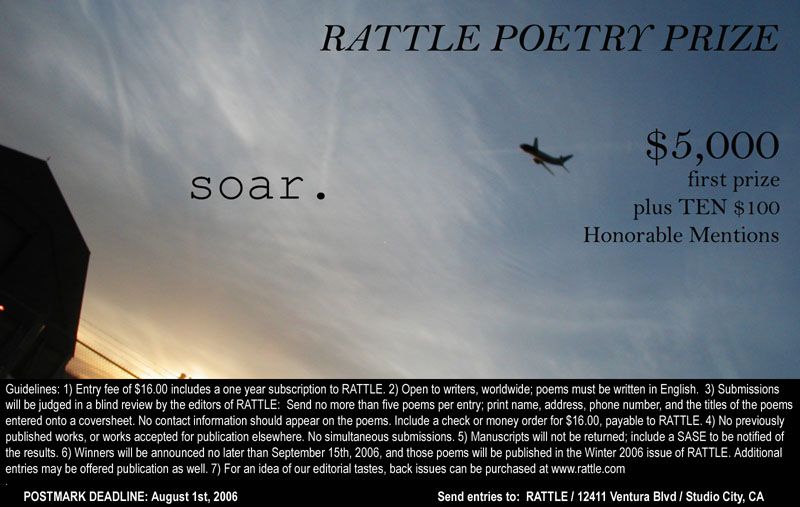
Meanwhile, this announcement from the folks at Rattle (you'll see ads in P&W and elsewhere before long).

(Click on the image to see it larger so you can read the rules. It's worth checking out -- looks like a decent contest, with a nice fat prize!)
Meanwhile, this announcement from the folks at Rattle (you'll see ads in P&W and elsewhere before long).
(Click on the image to see it larger so you can read the rules. It's worth checking out -- looks like a decent contest, with a nice fat prize!)
Wednesday, January 04, 2006
MIA
Sorry I've been a bit MIA for the past few days -- the Martian Death Flu has more or less melted my brain. I've been crashed-out on the couch, drinking lots of orange juice, and watching lots of football. Football. That's how you can tell I'm really not myself.
Better soon, I'm sure.
For those who commented on the new profile pic -- it was taken by Laine at the Five Women Poets reading last October. I believe I was reading "Hold," one of my Provincetown poems, and I was being a big nerd and waving my arms around as I read the line about cormorants' wings.
Really, I just want to be a rockstar. They can get away with waving their arms around and all kinds of other grand gestures that poets mostly can't manage without looking pretty silly. On a scale of one to Bono, I mostly just stand there boringly while I read.
My poem "The Swarm" is now posted on Rattle's website, for the curious or bored amongst you. Ignore the superfluous last name a few lines from the end -- I think that's where the page break was. Oopsie. :)
Now if you'll excuse me, I'll go back to my couch and my football and my Martian Death Flu. Get your flu shots, people. You don't want to feel like this. (Okay, it's probably just a cold and I'm just being dramatic. The flu is probably worse. But what kind of a poet would I be if I didn't exaggerate for effect now and then?)
Better soon, I'm sure.
For those who commented on the new profile pic -- it was taken by Laine at the Five Women Poets reading last October. I believe I was reading "Hold," one of my Provincetown poems, and I was being a big nerd and waving my arms around as I read the line about cormorants' wings.
Really, I just want to be a rockstar. They can get away with waving their arms around and all kinds of other grand gestures that poets mostly can't manage without looking pretty silly. On a scale of one to Bono, I mostly just stand there boringly while I read.
My poem "The Swarm" is now posted on Rattle's website, for the curious or bored amongst you. Ignore the superfluous last name a few lines from the end -- I think that's where the page break was. Oopsie. :)
Now if you'll excuse me, I'll go back to my couch and my football and my Martian Death Flu. Get your flu shots, people. You don't want to feel like this. (Okay, it's probably just a cold and I'm just being dramatic. The flu is probably worse. But what kind of a poet would I be if I didn't exaggerate for effect now and then?)
Saturday, December 31, 2005
Happy New Year 2006
Happy New Year, all! I seem to have picked up some kind of Martian Death Flu on my holiday travels (okay, it's just a yucky cold, but Martian Death Flu sounds more glamorous) so my first resolution for 2006 is to rest and drink orange juice and get myself healthy again. Whatever you are doing tonight, I hope you are warm and safe and happy. I wish you all a peaceful, creative, and successful (that word -- whatever it means to you!) year in 2006.
Friday, December 30, 2005
From flyover country
The new Indianapolis Airport, now under construction, is apparently going to be chock-full of art. What a cool thing. Even better, they are looking for poems by Indiana poets, as one of the proposed works of art is going to feature poetry on it.
If they pick one of mine, y'all have to start planning your travel so as to connect via Indianapolis, just so you can go "ooh! I know that poet!" :)
And in honor of the new year (and for me personally, a return to sending stuff out after a brief hiatus), this bit o'sanity from http://garyjkelly.com/ai/cheer.htm:
Rejection Blues?
A cockroach will live nine days without its head, before it starves to death. A publisher won't.
If they pick one of mine, y'all have to start planning your travel so as to connect via Indianapolis, just so you can go "ooh! I know that poet!" :)
And in honor of the new year (and for me personally, a return to sending stuff out after a brief hiatus), this bit o'sanity from http://garyjkelly.com/ai/cheer.htm:
Rejection Blues?
A cockroach will live nine days without its head, before it starves to death. A publisher won't.
If you yelled "I've been rejected!" for 8 years, 7 months and 6 days, you would have produced enough sound energy to heat one cup of coffee.
Banging your head against a wall uses 150 calories an hour and hurts. Posting another submission takes seconds and doesn't.
Remember, when someone annoys you, it takes 42 muscles in your face to frown. But, it only takes 4 muscles to extend your arm and smack the w****r in the head. Or post a submission to another publisher.
If you fart consistently for 6 years and 9 months, enough gas is produced to create the energy of an atomic bomb. If you wrote a short story every day for the same period, you'd have about 2469 stories to submit and your home would be a much nicer place to visit.
The male praying mantis cannot copulate while its head is attached to its body. The female initiates sex by ripping the male's head off. Unless the publisher that rejected you happens to be a male praying mantis, telling him to f*** off will not have the same effect.
A pig's orgasm lasts for 30 minutes. The publisher that rejected you is certainly not a pig...
An ostrich's eye is bigger than its brain. (We know some people like that, don't we?)
Starfish don't have brains. (We know some people like that, too)
Some lions mate over 50 times a day. Publishers would need to be lions if rejected writers could only get mental telepathy to work.
If publishers really knew the secret of what makes a good book "good", they'd be writers.
The following have had books published: Jeffrey Archer, Joan Collins, Jackie Collins, Roy Hattersley, Salman Rushdie.
Are you really thinking of giving up now?
Subscribe to:
Posts (Atom)