Phew. Just finalized a 30-page chapbook ms. for a contest. (The guidelines specify 25-40 pages, so 30 sounds good to me.) I think in the process I identified something new to write about. The ms. has 2 sections, one on home and the body and one with poems about animals (not that animals don't show up quite a bit in the first section...), and I started thinking about the connection between the two. I stole a couple lines from Mark Doty as an epigraph for the second section: "and on the street a few men knew what I wished: / that my plain clothes hid hooves and haunches." (from "Now You're an Animal") And I think that I wish my relationship with "home and the body" (two concepts I tend to conflate in the first-section poems) were as uncomplicated as an animal's relationship with its body. Okay, that's a big oversimplification, but if Mister Norton Anthology is reading this, clip'n'save just in case I ever get famous, because there's your first footnote. ;)
(And yes, I've totally misappropriated the Doty lines in a way -- what he meant by them is kind of different from what I'm working with -- doh! -- but I think they add kind of a cool dimension to the animality [is that a word?] of the poems in my second section. So.)
The epigraph for the first section is a couple lines from an Indigo Girls song. Sometimes I am such a lesbian.
I wish chapbook contests would be a little more uniform in their requirements, because this other one that I'd like to enter has a 15-20 page specification. I think that means if I want to enter, I'm going to have to start from scratch and do an entirely different manuscript. I guess I could take one section from this ms. and add a couple extra poems, though. Well, that's for later. I've barely done any reading this weekend, and haven't even touched my journal in days and days, so I think the rest of this evening -- what precious little there is left of it -- will have to be devoted to reading & writing.
Which is not, after all, such a bad note on which to end the weekend.
Sunday, May 01, 2005

Friday, April 29, 2005
Ambiguous rejection & fun with manuscripting
I realized today that the problem with submitting one's work via email or web form (and thus receiving an emailed response) is that it's a lot harder to tell whether you're getting an encouraging rejection or just a regular one. When you get a paper rejection slip with "try us again" inked on it, you know that not everybody got that same note and you take heart a little. (Unless, of course, you're at that point of being sick to death of getting little inked notes and no acceptances, in which case it makes you gnash your teeth a little.)
But with email, unless you've had emailed rejections from the same journal before & know what their standard wording is, it's hard to know whether "The poems have gone through many hands, with interest" is just a continuation of the apology for holding the work so long (six months, in this case) or whether it means they really did kind of like the poems. Argh. Oh well, I'll choose to take it as mild encouragement, because I need that right now, and also because this particular journal is one I'd really really love to get into. (Plus, at the end it's signed "The Editors" but then it has one editor's name in parentheses -- so I'm going to pretend that means this note came personally from that editor and is not, in fact, the standard rejection form email. Or rather, that it started off with the standard rejection template but that this editor added stuff to be encouraging.)
Ah, the mind games publication -- or the hope thereof -- makes us play.
This weekend I want to finalize the new(ish) chapbook ms. and get it sent off to one or two contests -- especially since I got a rejection for the older ms. this week (it's still out to one place). I'm a little tired of the whole contest idea right now, but putting together the manuscript is a good exercise and teaches me something about my work, and I probably won't bother doing that without the incentive of having somewhere to send it, so contest submission it is. That, I think, is one of the few ways in which the actual writing (which is the important part) does intersect with submitting and publishing (which is the hobby part), and one of the few ways in which the publishing part actually does the writing part some good. I would write poems no matter what, even if some god descended from the heavens and told me that I was fated never to have another poem accepted anywhere again. But would I bother putting together manuscripts? Probably not. Putting poems together in book (or chapbook) format is, for me, a way of organizing the poems and presenting them for other people -- they already have plenty of context and narrative arc or whatever in my own mind, I don't need to put them in any order to get that for myself.
Although the process does teach me something about my work -- the last chapbook ms. I put together made me realize I do have a couple of overriding themes over the past couple years or so, and made me feel like I am writing towards something & not just haphazardly strewing poems. I don't think I'd bother doing it without the eventual goal (cross your fingers) of publication, but that doesn't mean I'm not glad to have done it/to be doing it.
Which makes me wonder why other people put together manuscripts -- would you do it if you knew it would never ever get published? And what have you learned from the process of organizing a ms. (or writing towards one, for those of you who consciously write towards one specific project at a time)? What does the "book process" give you as a writer? After putting together a first book that you're happy with (whether it gets published or not), do you feel differently about your writing? Does your poetry change at that point?
Is trying to get published a guilty pleasure? I think I've come to the conclusion that it is one of mine. Hee.
Wednesday, April 27, 2005
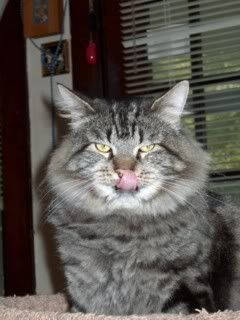
National Hairball Awareness Day
For all the cat lovers out there: Today is National Hairball Awareness Day. You may celebrate by watching this jolly little musical interlude:
http://www.bigshotmedia.com/hairball/
With love from this guy:
http://www.bigshotmedia.com/hairball/
With love from this guy:
Monday, April 25, 2005
midlife checks and balances
Today I was emailing back and forth with a colleague and something she said reminded me of the Liz Phair song "Fuck and Run" and I wanted to tell her that but for the life of me I couldn't come up with the name Liz Phair. So I thought I'd google for it, and tried to think of some of her other songs, and "Supernova" got stuck in my head but I couldn't think of the title of the song for anything. I thought of googling for the line "fuck like a volcano" but I didn't really want that in my search history at work. The same went for the title "Fuck and Run" but I finally couldn't stand it anymore and plugged that phrase into Google and I was in business.
Man, I hate getting old. Short-term memory is the first to go. Next I think is attention span, and
...oh man. Where was I?
Anyway.
**********
On good days, reading blogs leads me directly into reading poems, and I shut the laptop and go into my study and sit down at my desk and read for a while and then I write for a while.
Other days, not so much.
I am trying to find some kind of balance. And the unread book pile is appallingly high.
Whalesong
(Alternate post title: Land Mammal and the Whales -- yes, it sounds like a bad garage band)
**********
If you go to whalesong.net and scroll down to the April 22 entry in the "Whalesong Log," you can hear something remarkable. A Maori woman named Raina Ferris visited Maui and went out in a boat to chant a traditional Haka. Several whales came near and -- I swear to god -- sang along. It's quite remarkable, and worth downloading.
There is something about this chant and the whalesong that has a completely overwhelming effect on me. The first time I listened to it, tears started streaming down my face. I know this makes me sound like a total woo-woo whale-hugger or something (and yes, I have seen the movie Whale Rider -- I've seen it at least a half-dozen times -- and yes, I cry during that too). I do not think that whales are any more spiritual, gentle, or intelligent than any number of other species, although I do believe they are fairly intelligent. (They ain't gentle, though. I have seen huge male humpbacks competing over females, and it's rather violent.) I do not think that whales were put on this planet to teach us a cosmic lesson. I do think whales are amazing and beautiful creatures. And my own interest in whales has led me to read more widely about environmental issues in general and to become more aware of my own footprint on this damaged planet.
But ... just go listen to the song. It's quite beautiful.
**********
In December 2000, I finished up my Master of Library Science degree. My mom gave me a whopper of a graduation present -- a check large enough to go take a week's vacation somewhere. I thought long and hard about it, and realized that I wanted to go whale-watching. I'd begun reading a bit about whales, my interest having been sparked a few years earlier when I visited a then-girlfriend in Delaware & saw a large pod of dolphins swimming and leaping not far offshore. They were cool -- and if dolphins were that cool, how amazing must whales be?
So I took my graduation money and I went to Provincetown. Okay, I wasn't just there for the whales; P-town is a queer vacation paradise, and it has lovely B&B's and funky little shops and terrific fresh seafood and neat little bookstores and live music all over the place. I went out whale-watching for the first time and when I saw my first humpback -- a female, which the naturalist on board identified as "Giraffe," a fairly well-known individual -- I just about cried. There's something so beautiful about these animals, the grace of their flukes, the unhurried way they go about their business.
Now, I had been writing very little for several years at this point. There were lots of reasons for this -- the death of my father, a relationship that was first wonderful (and took up all my energy) and then disastrous (and took up all my energy), then several years of working full-time while going to library school half-time. I thought maybe all the writing had dried up in me. But a week in the amazing clear light of Provincetown, the total relaxation of having no obligations other than to go sit on the beach with a book and maybe go out whale-watching again, and the ... something ... that those whales stirred up deep inside me -- well, I started writing again. Hesitantly, clumsily, but I could tell it was still there for me.
Later that summer I came into a few unexpected dollars and found a cheap airfare, so I zipped back out to P-town in early September. My last morning there -- September 10, 2001 -- I caught the early morning whale-watch, and saw a young whale (whose mother was identified as "Owl") breaching, leaping from the water over and over, apparently just for the joy of being a young playful mammal. I flew back late that night, the last flight of the evening from Boston to Chicago, the last flight of the evening from Chicago to Indianapolis. And then, well, after the next morning there were no more flights for a while.
At this same time there was a North Atlantic right whale -- an extremely endangered species, with perhaps 350 individuals remaining -- entangled in fishing gear off the New England coastline. He was first sighted in June, about the time I first visited P-town; several rescue and disentanglement attempts were made throughout the summer, garnering a fair amount of news coverage, but he grew more and more sickly and emaciated with each sighting. On September 16, though the news wasn't paying much attention at that point, the radar beacon attached to a buoy on the trailing gear went silent, and the whale was presumed dead.
I remember sitting in Bryan Park, a big green expanse of grass and trees and little rolling hills, a few days after I got back to town. I needed to feel my skin in contact with the earth, the healing of that. I sat on the grass in the park and wrote about whales; about the young whale breaching over and over with such exuberance; about the right whale as his skin turned ghostly white and he finally sank in silence; about the breaching of boundaries, how so many people's sense of safety had been breached a few days earlier. The earth brought me solace and the writing, though it didn't bring me understanding, brought me some measure of peace. It was the first time in several years I'd found that through writing and it felt like coming home.
Would I have come to that point without whales? Maybe. Probably. But I still credit whales for some of it. I will always try to go on a whale-watching vacation every few years. (In February 2002, I went to Maui for the first time, also for the whales -- and found a whole lot more than whales -- but I'll save that for another post. Which is pretty funny, since this whole post started off with listening to Maui whales.) When I go to Provincetown in June for my workshop with D.A. Powell, you can bet I'll be on board the Dolphin Fleet boats at least a couple of times, binoculars and camera at the ready, tasting the salt air on my lips, letting the wind tangle my air, scanning the waves for the slightest flash of fluke. I can't swim for shit, but being out on the ocean like that feels like home in a way this landlocked Midwestern girl can't ever explain.
**********
This is the only sestina I have ever written. It's not what I wrote that day in the park -- that turned out to be a prosepoem, and it's not that good. This, I wrote the following summer, during the IU Writers' Conference, inspired by my workshop with Lucia Perillo, a class on forms with Karen Volkman, and a class on "poetry of the changed world" with Roger Mitchell.
**********
If you go to whalesong.net and scroll down to the April 22 entry in the "Whalesong Log," you can hear something remarkable. A Maori woman named Raina Ferris visited Maui and went out in a boat to chant a traditional Haka. Several whales came near and -- I swear to god -- sang along. It's quite remarkable, and worth downloading.
There is something about this chant and the whalesong that has a completely overwhelming effect on me. The first time I listened to it, tears started streaming down my face. I know this makes me sound like a total woo-woo whale-hugger or something (and yes, I have seen the movie Whale Rider -- I've seen it at least a half-dozen times -- and yes, I cry during that too). I do not think that whales are any more spiritual, gentle, or intelligent than any number of other species, although I do believe they are fairly intelligent. (They ain't gentle, though. I have seen huge male humpbacks competing over females, and it's rather violent.) I do not think that whales were put on this planet to teach us a cosmic lesson. I do think whales are amazing and beautiful creatures. And my own interest in whales has led me to read more widely about environmental issues in general and to become more aware of my own footprint on this damaged planet.
But ... just go listen to the song. It's quite beautiful.
**********
In December 2000, I finished up my Master of Library Science degree. My mom gave me a whopper of a graduation present -- a check large enough to go take a week's vacation somewhere. I thought long and hard about it, and realized that I wanted to go whale-watching. I'd begun reading a bit about whales, my interest having been sparked a few years earlier when I visited a then-girlfriend in Delaware & saw a large pod of dolphins swimming and leaping not far offshore. They were cool -- and if dolphins were that cool, how amazing must whales be?
So I took my graduation money and I went to Provincetown. Okay, I wasn't just there for the whales; P-town is a queer vacation paradise, and it has lovely B&B's and funky little shops and terrific fresh seafood and neat little bookstores and live music all over the place. I went out whale-watching for the first time and when I saw my first humpback -- a female, which the naturalist on board identified as "Giraffe," a fairly well-known individual -- I just about cried. There's something so beautiful about these animals, the grace of their flukes, the unhurried way they go about their business.
Now, I had been writing very little for several years at this point. There were lots of reasons for this -- the death of my father, a relationship that was first wonderful (and took up all my energy) and then disastrous (and took up all my energy), then several years of working full-time while going to library school half-time. I thought maybe all the writing had dried up in me. But a week in the amazing clear light of Provincetown, the total relaxation of having no obligations other than to go sit on the beach with a book and maybe go out whale-watching again, and the ... something ... that those whales stirred up deep inside me -- well, I started writing again. Hesitantly, clumsily, but I could tell it was still there for me.
Later that summer I came into a few unexpected dollars and found a cheap airfare, so I zipped back out to P-town in early September. My last morning there -- September 10, 2001 -- I caught the early morning whale-watch, and saw a young whale (whose mother was identified as "Owl") breaching, leaping from the water over and over, apparently just for the joy of being a young playful mammal. I flew back late that night, the last flight of the evening from Boston to Chicago, the last flight of the evening from Chicago to Indianapolis. And then, well, after the next morning there were no more flights for a while.
At this same time there was a North Atlantic right whale -- an extremely endangered species, with perhaps 350 individuals remaining -- entangled in fishing gear off the New England coastline. He was first sighted in June, about the time I first visited P-town; several rescue and disentanglement attempts were made throughout the summer, garnering a fair amount of news coverage, but he grew more and more sickly and emaciated with each sighting. On September 16, though the news wasn't paying much attention at that point, the radar beacon attached to a buoy on the trailing gear went silent, and the whale was presumed dead.
I remember sitting in Bryan Park, a big green expanse of grass and trees and little rolling hills, a few days after I got back to town. I needed to feel my skin in contact with the earth, the healing of that. I sat on the grass in the park and wrote about whales; about the young whale breaching over and over with such exuberance; about the right whale as his skin turned ghostly white and he finally sank in silence; about the breaching of boundaries, how so many people's sense of safety had been breached a few days earlier. The earth brought me solace and the writing, though it didn't bring me understanding, brought me some measure of peace. It was the first time in several years I'd found that through writing and it felt like coming home.
Would I have come to that point without whales? Maybe. Probably. But I still credit whales for some of it. I will always try to go on a whale-watching vacation every few years. (In February 2002, I went to Maui for the first time, also for the whales -- and found a whole lot more than whales -- but I'll save that for another post. Which is pretty funny, since this whole post started off with listening to Maui whales.) When I go to Provincetown in June for my workshop with D.A. Powell, you can bet I'll be on board the Dolphin Fleet boats at least a couple of times, binoculars and camera at the ready, tasting the salt air on my lips, letting the wind tangle my air, scanning the waves for the slightest flash of fluke. I can't swim for shit, but being out on the ocean like that feels like home in a way this landlocked Midwestern girl can't ever explain.
**********
This is the only sestina I have ever written. It's not what I wrote that day in the park -- that turned out to be a prosepoem, and it's not that good. This, I wrote the following summer, during the IU Writers' Conference, inspired by my workshop with Lucia Perillo, a class on forms with Karen Volkman, and a class on "poetry of the changed world" with Roger Mitchell.
[poem deleted; if you want to see it, comment or backchannel me]
Sunday, April 24, 2005
moldy oldie
Just for fun... if I had to haul out one of my poems to represent me, this would probably be the one. (Is that kind of like a parent admitting they like one of their children best?) It also got me the nicest acceptance letter I've ever gotten, so I'd probably have a soft spot for it for that reason alone.
Let X Equal . . .
Let the woman wake
from sleep, as she does each morning
of her life. Let her arm
reach out, drowsy, and brush
the bedroom curtains aside,
let her watch for five whole minutes
the cat washing herself
on the front lawn, the bird
pecking madly at damp earth,
the neighbor clutching the front of her robe
as she steps out the door
and stoops for her morning paper.
Let the sunlight be quiet
and warm across the lawn. Let the grass
be succulent and green.
Let the day unfold like a perfect
equation, every moment growing
toward some simple answer,
some singular integer.
Let the woman stand for the thesis,
the given, all the formulas that build
a body of knowledge. Let her waking
be the question, and the window
equal some visible understanding, the work
she is asked to show. Let the neighbor
and the curtains be variables, the light
and the lawn be the sum
of each other, the pure reciprocity of morning.
Let the woman's hand, opening
curtains, and the woman, rising,
be a new theorem, solid and given,
the beginning of an elegant
and irrefutable proof.
-A.H. 1990
published in Northwest Review, 1992
and in Celebrating Seventy, compiled by Jenny Kander (Lexington, KY: Wind, 2003)
Saturday, April 23, 2005
It's like Christmas...
...but not because it's cold (although it is, 40 degrees today and blustery, with a freeze warning for tonight). No, it's like Christmas because it was a Good Mail Day today: Bruce Springsteen's new CD (which I pre-ordered, and now I have it before its official release date on Tuesday -- I feel special), and my order from Tupelo Press (books by Patricia Fargnoli and Ilya Kaminsky).
The Tupelo order just went in on Monday afternoon, and already I have the books in hand. Not only do they do gorgeous books with terrific poetry in them, they provide good service. Yep, I'm a fan.
And speaking of being a fan ... I'm listening to Springsteen now. This is, I think, very much a writer's album. His primary concern in these songs seems to be the creation of characters and the spinning of tales. It's not really new ground for him, but he does it so well. And the sound is, as early reviews have noted, a lot like the "Tom Joad" stuff but informed by the full-band sound of "The Rising." Themes: family, loss, bleakness, hope, the salvation brought by love (and sex). You know, the usual Brucely stuff. I really like the production on this (Brendan O'Brien again) although I'm sure a lot of Bruce fans will fuss that there's too much crammed in on it.
There ain't nothing like the E Street Band in full swing, and this is not that. But it's good stuff nonetheless. And the writing -- well -- I love how he picks out details that tell us something about his characters, how he uses the passage of time within each song, how he focuses on specificity. I know it's nothing new to compare Springsteen to Dylan, but a lot of this material does kind of remind me of Dylan, the "Tangled Up in Blue" Dylan.
He's on VH-1 "Storytellers" tonight. That should be just plain fun.
Wednesday, April 20, 2005
Rambly little tidbits
Thanks to everyone who gave me congratulations on the Poetry Midwest acceptance. Comments aren't playing well with others tonight so I'll respond to a couple things here...
Jennifer: "Garretless non-carousal"! I love it. That would be a great blog title.
Woody: Thinking?! Uh-oh... should I duck? ;)
Charles: I did not do the dance, because I was at work and they already think I'm weird. I did manage a bit of a seated butt-waggle though.
Poetry Midwest took a poem of mine called "Door" last year. The one they're taking for the upcoming issue is called "Windows." I think in order to keep getting published by them I'm going to have to write a poem called "Chimney" ... or perhaps "Joist" or "Soffit."
Note to self: two pieces of colby-jack cheese and a handful of slightly stale croutons does not constitute a proper dinner. Good grief.
Finally: Does anyone have any "inside scoop" on Notre Dame's MFA program? Don't get excited, it's mostly just idle curiosity. I did notice when I poked around on their website that two of their poetry faculty (Sonia Gernes and John Matthias) are retiring this year, but I have no idea who's coming in to take their places.
Notre Dame has a lovely new-ish bookstore on campus. I've only been there once, but next time I visit my mom (who lives quite close to the ND campus) I think I'm going to try & visit it again.
That's all for tonight, just rambly little tidbits. Oh, and now the truck that was blocking me into my driveway has moved, so I can leave the house and go get some proper food. GOOD.
Tuesday, April 19, 2005
Broke the streak...
...of rejections at last. Poetry Midwest took one of mine for the summer issue. Cool. They're still reading for this issue till June 13, in case anyone else wants to submit some stuff.
Good snailmail today too: my tax refund from Indiana (I e-filed, but for some reason the website wouldn't take my routing number for direct deposit, so I said the heck with it and let them cut me a check -- hey, it was only 8 bucks, how much of a hurry could I be in to get it), a $10 check from the Kinsey Institute for a questionnaire I filled out, a "$10 off any $25 purchase" coupon from Lowe's, and the new issue of the Writer's Chronicle (hopefully this one won't suffer the same fate as the last one, which went astray on recycling night and got recycled before I was finished reading it).
Thinking, in the aftermath of Li-Young Lee's reading and the comments people made, about what we expect a poet to be like. Some people expressed dismay at what they perceived as a lack of professionalism or a lack of respect for the audience; some expressed delight at what they perceived as a bit of poet-y wildness. Should poets be wilder than regular people? If so, I think I'm in trouble; besides the fact that I don't always fully conform to gender roles and (like the librarian I am) I tend towards comfortable shoes, I don't think I come across as particularly wild or mysterious at all. I make every effort to avoid unnecessary drama and angst in my personal life. (I'm not particularly interested in dying young, either.) Does that mean I suck as a poet? I sure as hell hope not.
But are poets somehow fundamentally different from non-poets? I don't know. I used to think "creative people" saw the world differently from others, and this might be true to some extent, but if it is, then "creative people" has got to be expanded to include scientists and other people actively engaged in some kind of investigative process -- I sometimes think poets have more in common with scientists than with painters, and that writing is most fruitfully seen as a process of investigation and discovery. (There are flaws with that analogy, especially in that the writing process is much less clearly defined than the scientific method, but I think it's a useful analogy nonetheless.)
The more I read about science, the more I realize how completely everything -- everything -- is intertwined. Right now I'm reading a book about the conflict between whale conservation and the commercial fishing industry (Entanglements: The Intertwined Fates of Whales and Fishermen by Tora Johnson) -- there is such a complex web of interactions governing, well, everything; the reproductive success of the right whale depends on the abundance of a particular type of plankton (copepods), and the success of the copepods depends on ocean currents and water temperature, which depend on the overall climate of the Earth and things like El Nino, which are in turn changed and influenced by human activity -- and humans' survival depends on the survival of phytoplankton, which are eaten by copepods, and which are responsible for the production of a large percentage of the planet's oxygen. (Even that's an oversimplification, but you get the idea.) Scientists have a responsibility to see, simultaneously, the macro and the micro, and to understand all the tangled, complex interrelationships among ... everything. So much that on the surface appears completely unrelated is at heart utterly interdependent. And I think poets also have a responsibility to see connections that aren't immediately obvious; in fact, I would say that revealing unexpected connections is one of the hallmarks of a good poem.
Anyway, that's a bit of a tangent, although I feel like it does have something to do with the question of who a poet should be. I think that poets have to be curious and open to the unexpected, but I don't think that means we have a responsibility to be "weird" or whatever.
Actually, I think poets are about like regular people in that there are all kinds of us -- wild, boring, bizarre, professional -- and I think it's the poetry itself that we should put our expectations on. Although, of course, without the creative/investigative process of actually writing, the poetry wouldn't exist in the first place.
More later, perhaps.
Monday, April 18, 2005
The best thing...
...anyone said in comments on my post about Li-Young Lee's reading came from Didi:
Well,
You are one with God when you write. You are one with man when you read.
That is all I have to say about that.
Lot of work I want to do tonight, several poems I know I want to revise, but I have a splitting headache. I got some poems back today (as in rejected) and wanted to figure out where to fire them off next, but I may just go to bed. I got two packets sent out today, so I have a total of eleven packets out at the moment ... maybe I'll just wait until some more come back and shuffle them around a bit. I'm feeling a bit head-to-brick-wall-ish about publication right now, as I haven't had an acceptance in a while; I think the cure for that is probably not to think about it for a bit and to spend more time writing -- which is, after all, the point.
Edited to add: Hey, I found the blog of someone who actually did take notes at LYL's reading. Here, if you're interested.
Sunday, April 17, 2005
Why can't every day be like today?
Today was a good day. The weather was perfect beyond perfection; I drank just a smidgen too much coffee (which nearly always propels me into productivity one way or another); I spent the entire afternoon reading and writing & plan to do more of the same this evening. I finished reading Mark Doty's newest volume, which is wonderful and something I'll be returning to. I drafted a couple of new poems (one perhaps a bit overmuch inspired by Doty, but revision should make that a bit less obvious at least) and revised another. WFHB (our volunteer-run community radio station) aired a particularly interesting installment of their weekly series "A Cycle of Poets" this evening, featuring Jenny Kander interviewing poet Roger Mitchell and his wife, fiction writer Dorian Gossy -- there was a bit of cross-genre discussion of language, and Dorian said some nice things about how poetry has influenced her fiction, particularly (though I don't think you'd necessarily guess it just from reading her) LANGUAGE poetry. That's made me think about how good it is to admit influences that stem from impulses very different from your own natural ones & to read work that's very different from your own.
Which reminds me, I'm also reading the new issue of Bloom. I love that journal, the range of work they publish. Really need to send them something.
**********
Bumper sticker of the week:
I love my country ...
... but I think we should start seeing other people.
Which reminds me, I'm also reading the new issue of Bloom. I love that journal, the range of work they publish. Really need to send them something.
**********
Bumper sticker of the week:
I love my country ...
... but I think we should start seeing other people.
Saturday, April 16, 2005
Lesbian Academic Love Poem
Because I know at least a few of you out there will appreciate this (hi Em and Julie)...
Lesbian Academic Love Poem by Sara Jane Stoner
Lesbian Academic Love Poem by Sara Jane Stoner
book sale finds!
Just finished fighting my way through the IU Library book sale. Boy, I found some good stuff. There was more I could have bought -- a few hardcover poetry books -- but I kept reminding myself that these books are actually IN the library and I can check them out ANYTIME and even for cheap, I should only buy the ones I actually want to *ahem* OWN.
But I did spend eight bucks. Here's what I got:
Hardcover ($3.00)
The Writings of John Lennon (combined edition of In His Own Write and A Spaniard in the Works)
Paperback ($1.00 each)
Wallace Stevens - The Necessary Angel: Essays on Reality and the Imagination
May Sarton - The House by the Sea
Frank O'Hara - Lunch Poems (Pocket Poets edition)
Dylan Thomas - Under Milk Wood
Journal Issues (25 cents each!)
Poetry - June 1933, June 1966, October 1967, August 1974
The August 1974 Poetry has perhaps the worst cover ever seen on a Poetry. It is, ah, very much a product of its times. It's pink and has two stylized naked people seen from behind, a man and a woman, with a serpent sneaking up behind them. I can't describe it adequately except to say it is very 1970's. Maybe I'll try to scan it.
From the "News Notes" section of the June 1933 issue:
This issue also includes the winner ("America Remembers" by Paul Engle) and honorable mentions from the "Century of Progress" contest. The "News Notes" section includes bionotes for the poets included, and mentions that
I am highly amused. :)
But I did spend eight bucks. Here's what I got:
Hardcover ($3.00)
The Writings of John Lennon (combined edition of In His Own Write and A Spaniard in the Works)
Paperback ($1.00 each)
Wallace Stevens - The Necessary Angel: Essays on Reality and the Imagination
May Sarton - The House by the Sea
Frank O'Hara - Lunch Poems (Pocket Poets edition)
Dylan Thomas - Under Milk Wood
Journal Issues (25 cents each!)
Poetry - June 1933, June 1966, October 1967, August 1974
The August 1974 Poetry has perhaps the worst cover ever seen on a Poetry. It is, ah, very much a product of its times. It's pink and has two stylized naked people seen from behind, a man and a woman, with a serpent sneaking up behind them. I can't describe it adequately except to say it is very 1970's. Maybe I'll try to scan it.
From the "News Notes" section of the June 1933 issue:
We apologize to Robert Tallman and our readers for a mistake, due to editorial carelessness, of a kind which never occurred before in POETRY's history -- the inclusion in the May number of a poem which had already appeared in February. The editor's Mexican trip must have cleared her mind of other matters, and Mr. Tallman, because of a change of residence, received his May proof just one day too late to correct the error.
This issue also includes the winner ("America Remembers" by Paul Engle) and honorable mentions from the "Century of Progress" contest. The "News Notes" section includes bionotes for the poets included, and mentions that
The editor's own poem, on a Century of Progress subject but not contributed to the contest, took her by surprise on the train in January.
I am highly amused. :)
Thursday, April 14, 2005
book sale
For anyone who might be in or near the Bloomington, IN area (and if you are, freakin' introduce yourself already!):
Giant Book Sale!
Well, the books are normal size, but it is a really big sale....
InULA (Indiana University Librarians Association) Book Sale will take place Saturday and Sunday in the Herman B Wells Library (Main Library), room E174. (If you go in the main lobby doors on the parking lot side of the library, this room is in between the two sets of doors.)
Preview sale 9 am to noon Saturday, $20 admission.
Free admission from noon-5 pm Saturday and 11 am-2:30 pm Sunday.
Books sold by the bagful (SUPER CHEAP) from 3-5 pm Sunday.
I have found lots of really cool stuff at this sale in years past, including some nifty out-of-print poetry books and -- the coolest find -- the 1979 edition of Who's Who Among American High School Students, which I didn't buy when I had the chance (yes, my name is in it) because it was ridiculously expensive -- but for a dollar, twenty-plus years later, I snapped it up and gave my mom a thrill.
I'm thinking I may not allow myself to go. I need more books in this house like I need more cat hair in this house.
An odd reading
OK, OK, I knew someone would ask. Yes, Li-Young Lee's reading Monday night was odd. I don't want to speculate about what's up with him; and I don't know how unusual this reading was for him, as I've only seen him read a couple of times, and the most recent one was in the rather controlled context of the IU Writers' Conference. And I'm not "in the loop" of MFA-program gossip, so I don't know what's being said or what transpired at his Q&A/discussion on campus the following morning. (I would've loved to have gone, but there is this little working for a living thing they make me do during the day.) I don't know how much of what transpired was pure theatrics.
Anyway. Cathy Bowman stepped up to introduce Lee, and after giving the usual quick biographical sketch, she asked the audience to say in unison the phrase "God in Man." This apparently had to do with a conversation the two of them had been having. The audience complied, sounding a bit confused. Lee stepped up to the podium with the requisite stack of papers & folders and water bottle. He said something about how that was what he wanted to write about, God in Man, but it always ended up being too much Man and not enough God, and he just wanted the God, or something. He started reading poems, but seemed frustrated, and before long he was revising poems as he read them -- stopping, shaking his head, going back and reading the stanza again with different bits in it. He expressed frustration quite a bit. Then he started reading a poem, talked about what wasn't working in the bit he had read (just a few lines) and how there were too many R sounds, finally put the poem down without reading past the first few lines. Cathy Bowman called out from the front row to ask him to finish the poem anyway. He didn't. (I was thinking at this point that it was kind of cool to see that maybe even Li-Young Lee has periods of thinking everything he has written is crap. Heh.)
At this point he seemed like he was going to go on reading poems, but he sort of went into ranting a bit. I wish I'd taken notes (although some of the bits I remember made their way into the poem I posted here). "I want to go home," he said several times, pounding on the podium. "You guys, I am in so much trouble up here. I want to get out of here, I want to go home, Cathy, I want to go home." He went on about God and Man and language, and I wish I'd been taking notes because there was a bit about a bird; he talked about how music and poetry and (a bunch of other stuff) wasn't the answer, sex was the answer, and we've got to get the sex thing right, sex isn't just about genitals but about the whole body, and if people would get sex right they wouldn't want to kill each other, and in fact the reason people kill each other is that they really want to fuck each other. He went on like this for oh, ten minutes maybe? fifteen? I wasn't really keeping track of time. Then he finally said something like "you guys just sit there, I'm leaving" and picked up his papers and his water bottle and left the room.
Cathy Bowman kind of looked around and went up to the podium as people applauded in a confused fashion. First she said that maybe that was just part one, but then I guess she realized he wasn't coming back, so she plugged the Q&A/discussion the following morning in Ballantine Hall, and said he'd be out in the lobby to sign books and so on (but I didn't see him as I left). All in all the reading was maybe 35 minutes or so, not a really unreasonable length for a reading I guess, though certainly shorter than I'd planned on -- and certainly much lighter on actual poetry!
I had a few thoughts about what was going on. Maybe he really was going through some kind of an emotional or existential or midlife or substance-related crisis and was just kind of falling apart. Maybe he was just having one of those "everything I've written is crap" days and couldn't deal with it. Maybe he was in the midst of working on an important new piece and he was so fully in the midst of the creative process that he couldn't talk to normal human beings at the moment (some of his ranting did kind of remind me of stuff I might mutter to myself as I pace around the house in the midst of writing a difficult poem). In a way it seemed like he was trying to read us poems that he hadn't actually written (or thought of) yet. Maybe he was just being a bit of a diva. I don't know. It certainly wasn't a boring stodgy academic Poetry-Voice reading, anyhow. And since I got a poem out of it, I'm not complaining....
**********
Edited later to add: Here's a blog entry from someone who was there & actually took notes, which (other than the poem I started drafting as I listened) I failed to do. It may be somewhat enlightening, since she got down more of what he actually said than I managed to.
**********
On a totally unrelated note, Amy Ray (of the Indigo Girls) just released her second solo album, Prom, and holy crap does it kick butt. Folkish-punky rock for the most part, with lots of electric guitars, some particularly excellent drumming from Kate Schellenbach, some cool melodies, and some fabulous lyrics. The whole thing is sort of a meditation (if you can meditate at the top of your lungs, haha) on high school, and how we learn about gender roles, and the intensity of being that age, and being queer in high school, and stuff like that -- some great lyrics like "I had a sex education without a word for my gender." I just got it on Monday (I'd pre-ordered it via Daemon Records) and already I've listened to it a half-dozen times. Good, good stuff.
Monday, April 11, 2005
a very rough draft
Li-Young Lee's reading tonight was ... odd. I'll leave it at that for now, except to say that I think he was trying to read us poems that he has not written yet.
However, it spawned a new poem for me. This is as rough as a rough draft gets; comments are welcome, but bear in mind I haven't really had a chance to read it myself yet! :)
The Problem of Birds
[deleted; if you missed it and would like to see it, comment here or backchannel me]
However, it spawned a new poem for me. This is as rough as a rough draft gets; comments are welcome, but bear in mind I haven't really had a chance to read it myself yet! :)
The Problem of Birds
[deleted; if you missed it and would like to see it, comment here or backchannel me]
Saturday, April 09, 2005
Palm
Trying to decide whether this one goes in the chapbook ms. or not... leaning towards not.
Palm
[deleted 04-12-2005; if you missed it & want to see it, comment here]
Palm
[deleted 04-12-2005; if you missed it & want to see it, comment here]
Saturday-night manuscriptin'
Landlocked Travels (shamelessly ganked from an Indigo Girls song, so possible copyright issues)
Animals at Home
The Landlocked Body
Landlocked Light
Landlocked Weather
Landlocked Luck
Stupid Stinkin' Chapbook
Untitled
---possibilities so far
I am either good or bad at titles -- there's no in between. I really liked "Breach" as a title, but this manuscript has changed so drastically that it just doesn't work anymore. Bah.
Thursday, April 07, 2005
"Nothin' matters and what if it did" --John Mellencamp, 1980
Jeez. First Creeley, now Bellow and Conroy. It's a bad month for writers.
Here's the Iowa City newspaper's Conroy obit.
I used to think "ugh, Iowa, who would want to go there, that program is mean." Then I went to the Iowa Summer Writing Festival a few times -- which is, I know, a completely different animal from the Workshop, but it gave me the opportunity to talk to a lot of people affiliated with the Workshop & several of its recent grads. And for all its faults, I think programs like that instill in one the understanding that writing MATTERS. Doing the work matters. Doing it as well as you can matters. It matters enough to hurt.
I came real close to applying to Iowa (& other programs as well, of course) then, around 1992 or so ... probably would not have been accepted, but who knows. Who knows how different my life would have been.
Anyway. Met up with Jenni yesterday evening at the Runcible Spoon; we talked poetry and blogging and read each other's chapbook mss. Didn't do any in-depth critique or anything, but it felt really good to talk about putting together a chapbook with someone else who's actively working on one -- my poetry-group colleagues aren't doing anything of the sort. Jenni's fun to chat with, opinionated (that's a good thing), and she's got some terrific poems in her manuscript. And it's always so good to spend time talking poetry with someone who cares passionately about it.
It matters, this poetry stuff. Not the po-biz of it, not the networking (though I find that fun sometimes, getting to know people and making small talk and everything), not the publishing -- publishing matters in the sense that it's one way of trying to chisel out a lasting space for your work, but that's a different kind of mattering. It's the poetry itself that really matters, both the process of writing it (and the learning/understanding process that goes along with the writing) and the poems that result.
That's why I feel so frustrated when I'm not writing well, when I'm not able to devote to it the kind of time I think it would take to become the best poet I could possibly become, when I can't figure out how to get better. Because it matters so much, and I don't want to give it half-assed attention. This isn't a hobby. It's a life.
I need to win the fucking lottery. Don't we all. *heh*
Monday, April 04, 2005
Still Life With NCAA Championship
Bad Poet No Donut, Part II: I found out that Ishle Yi Park's reading on campus was at 7:00, not 8:00 as I was originally told, and since I didn't get home from running errands until after 6 I decided not to go. I swear I'm going to hear Li-Young Lee next week come hell or high water, though. Although the MFA program is making it darned hard to do so, since they have yet to update their website with a time or location. Maybe I'll call the MFA office tomorrow, much as I hate making phone calls to people I don't know.
**********
As has been noted by several bloggers, news sites, et cetera, Ted Kooser has won the Pulitzer Prize in poetry, and Marilynne Robinson in fiction. (I really do need to pick up both of those books, as well as Brigit Pegeen Kelly's Pulitzer-nominated volume. Do you suppose people could stop publishing books for a few years so I can have a chance to catch up? Bloggers excepted, of course -- y'all can publish all you want. I'll just read faster.)
**********
Had a headache for three days. After work I had to run out to the vet clinic to pick up some Cosequin (tuna-flavored glucosamine chondroitin powder for the arthritic geriatric cat), and on the way back I took a spontaneous detour into a Starbuck's drive-thru. Mind, I don't patronize Starbuck's that much -- their coffee isn't that great and I'd rather support locally-owned establishments, although I do love Panera for some reason -- but my aunt gave me a Starbuck's card for my birthday almost a year ago, and I still haven't used it up yet, so I may as well. Anyhow I got a caramel frappuccino. As soon as I had finished half of it, I realized my headache was entirely gone. Mmmm. Magic caramel frappuccino. We'll just ignore the fact that those things have about 179463 calories in them.
**********
In today's mail: new books by Lucia Perillo and Mark Doty. I have been looking forward to Doty's book ever since I heard him read some of these poems in Provincetown in the summer of '03. "Heaven for Paul" in particular has stayed with me since that reading. I can just picture the two of them on that plane. And the combination of humor, tenderness, and understated wisdom in that poem blows me away. (I suppose it's best when he's reading it out loud with Paul in the audience though.) His "Heaven for Stanley" was especially moving as well that night, in the room named for Kunitz, the night after most of us in the audience had heard Kunitz read in that same room. It was pure serendipity that I managed to be there for those readings; I'd thought I wouldn't be able to afford to visit P-town that summer, but a semi-last-minute bargain airfare popped up, and when I checked the FAWC website to see who was reading in the next few weeks and realized I could hear Kunitz and Doty, I booked that puppy in a hurry and flew out for a long weekend. Well worth it -- both readings were truly special.
I'm pleased to have Lucia Perillo's book, too. I took a workshop with her at the IU Writers' Conference a couple of years ago -- 2002, I guess it was -- and enjoyed her immensely. Amusingly enough, I originally tried to get into Mark Doty's workshop that year, but sent in my application too late and his was already full. I was terribly disappointed at first, but as these things usually turn out, Lucia's workshop was absolutely the right one for me.
Also got the Indigo Girls' "Live at the Uptown Lounge" DVD -- I've had this on VHS since the early nineties (in fact, if I recall correctly, I purchased it with my winnings from the office NCAA tournament pool, the one and only time I won!), and am happy to have it now on DVD.
I am such a consumer.
**********
Speaking of consumerism, Jenni is in so much trouble. Caveat Emptor, our good used bookstore, is having a "Spring Cleaning" sale this week while she is in town -- 30% off all used books. I don't know if she has internet access where she's staying. Maybe I'll be kind and not tell her. Ssssshhhhhh.
She and I are going to try to meet up at the Runcible Spoon tomorrow evening to drink coffee and talk poetry, or to drink poetry and talk coffee, I'm not sure which. Although I've met tons of "Internet people" over the years, from various BBS's (I never know how to pluralize that) and from livejournal and from various listservs and such, this will be my first "blogger person" meeting.
So with any luck, by tomorrow night I will have Official Blogger Person Verification that I Am Not A Half-Crazed Axe Murderer in person. Er, I hope so anyway.
**********
As has been noted by several bloggers, news sites, et cetera, Ted Kooser has won the Pulitzer Prize in poetry, and Marilynne Robinson in fiction. (I really do need to pick up both of those books, as well as Brigit Pegeen Kelly's Pulitzer-nominated volume. Do you suppose people could stop publishing books for a few years so I can have a chance to catch up? Bloggers excepted, of course -- y'all can publish all you want. I'll just read faster.)
**********
Had a headache for three days. After work I had to run out to the vet clinic to pick up some Cosequin (tuna-flavored glucosamine chondroitin powder for the arthritic geriatric cat), and on the way back I took a spontaneous detour into a Starbuck's drive-thru. Mind, I don't patronize Starbuck's that much -- their coffee isn't that great and I'd rather support locally-owned establishments, although I do love Panera for some reason -- but my aunt gave me a Starbuck's card for my birthday almost a year ago, and I still haven't used it up yet, so I may as well. Anyhow I got a caramel frappuccino. As soon as I had finished half of it, I realized my headache was entirely gone. Mmmm. Magic caramel frappuccino. We'll just ignore the fact that those things have about 179463 calories in them.
**********
In today's mail: new books by Lucia Perillo and Mark Doty. I have been looking forward to Doty's book ever since I heard him read some of these poems in Provincetown in the summer of '03. "Heaven for Paul" in particular has stayed with me since that reading. I can just picture the two of them on that plane. And the combination of humor, tenderness, and understated wisdom in that poem blows me away. (I suppose it's best when he's reading it out loud with Paul in the audience though.) His "Heaven for Stanley" was especially moving as well that night, in the room named for Kunitz, the night after most of us in the audience had heard Kunitz read in that same room. It was pure serendipity that I managed to be there for those readings; I'd thought I wouldn't be able to afford to visit P-town that summer, but a semi-last-minute bargain airfare popped up, and when I checked the FAWC website to see who was reading in the next few weeks and realized I could hear Kunitz and Doty, I booked that puppy in a hurry and flew out for a long weekend. Well worth it -- both readings were truly special.
I'm pleased to have Lucia Perillo's book, too. I took a workshop with her at the IU Writers' Conference a couple of years ago -- 2002, I guess it was -- and enjoyed her immensely. Amusingly enough, I originally tried to get into Mark Doty's workshop that year, but sent in my application too late and his was already full. I was terribly disappointed at first, but as these things usually turn out, Lucia's workshop was absolutely the right one for me.
Also got the Indigo Girls' "Live at the Uptown Lounge" DVD -- I've had this on VHS since the early nineties (in fact, if I recall correctly, I purchased it with my winnings from the office NCAA tournament pool, the one and only time I won!), and am happy to have it now on DVD.
I am such a consumer.
**********
Speaking of consumerism, Jenni is in so much trouble. Caveat Emptor, our good used bookstore, is having a "Spring Cleaning" sale this week while she is in town -- 30% off all used books. I don't know if she has internet access where she's staying. Maybe I'll be kind and not tell her. Ssssshhhhhh.
She and I are going to try to meet up at the Runcible Spoon tomorrow evening to drink coffee and talk poetry, or to drink poetry and talk coffee, I'm not sure which. Although I've met tons of "Internet people" over the years, from various BBS's (I never know how to pluralize that) and from livejournal and from various listservs and such, this will be my first "blogger person" meeting.
So with any luck, by tomorrow night I will have Official Blogger Person Verification that I Am Not A Half-Crazed Axe Murderer in person. Er, I hope so anyway.
Saturday, April 02, 2005
I want to be a Girlyman
Sounds like you AWP-ers are having a good time! Maybe someday I'll get to go. I love that kind of thing -- conferences, festivals -- the intensity of it. I'm a fairly shy person, though I am relatively good at finding common ground with people and making conversation once I feel like I know them a bit -- though I tend to hang out on the fringes. I suspect my Provincetown trip/workshop in June is going to drain my travel/vacation budget for the next couple of years, so who knows when I'll make it to AWP -- but hopefully someday.
Right now I'm in full-on "wish I were a musician instead of a poet" mode though. I went to hear Girlyman last night and they were just so much fun. You haven't lived until you've experienced a queer-folk-singalong of "Rock Me Amadeus," in German and everything. And then there were songs like "Speechless" and "The Shape I Found You In" that just about made me cry. There are things you can do with music that you just can't do in poetry. Plus, of course, musicians get flirted with WAY more than poets do. Heh.
I did buy a Girlyman T-shirt, which will be especially fun to wear to my workshop in P-town.
I meant to get some writing done today but have had a headache most of the day. I know -- whine, whine, whine. Maybe this evening.
This is, I think, the world's most boring blog today -- so I will close.
Wednesday, March 30, 2005
By request...
As I posted in a comment on Emily's great blog post on poetry & ambition:
Anyhow, Em asked me to post the Cosmos poem so, uh, here it is. Remember, I was a mere child of 21 at the time. (eek!) Oh, and also, there was a running joke in the class about "snow in April," since it had (you can see this coming, right?) snowed in April, and almost every single person in the class trotted in with a poem about snow in April that week. So that's sort of an in-joke in this poem.
GRAPPLING WITH THE COSMOS
"Write a poem that tackles the big issues.
Grapple with the cosmos... "
--Roger Mitchell
I
in the grey April snow
me & the cosmos met
on the bad side of town
kicking litter out of the way
it was a face-off from the start
the cosmos, he had this grudge
against me, we traded insults
& fists for a while
he gave me a black
eye but I got him with a left
to the jaw
teeth were flying
we rolled around on the pavement some
when he stumbled out
of the alley there was nothing
but the wind bouncing off brick walls
scattering paper
II
it was one of those dark
& stormy nights in April, the kind
young writers are obliged to revel
in & I went to this bar
just to get a beer
sit at a corner table & write
a poem, but the cosmos followed me in
he used all the oldest lines in the book
I mean of all people
he should have been able to come up
with something I'd never heard
but I fell for him
turned out he lived
just around the corner, & in no time
we were wrestling in the dark
but I woke up at four
in the morning with darkness
on the other side of the bed & hunger
rattling the windows
found my way home where my friend
asked me where I'd been "oh out
grappling with the cosmos"
she's used to me being
a poet, or trying to, & didn't ask
what I meant by that just
fixed me a cup of catnip tea
"was it good for the cosmos too?"
spent the day watching clouds
change, never did
get that poem written
--A.H. 1982
published in Sidewalks, 1991
I remember when I was in my last undergrad poetry workshop, and a bunch of us had been -- as 21- and 22-year-olds will -- bringing in poem after poem about lost or unrequited love, childhood trauma, and the like. Toward the end of the semester, Roger Mitchell told us, "Write about the big stuff. Grapple with the cosmos."Edited to add: Apparently I was wrong -- Roger Mitchell's class was spring semester of my junior year. Maura Stanton's class, the following fall semester, was actually my last undergrad workshop. Not that anyone cares but me.
I then proceeded to write an extremely silly poem in which I encountered the Cosmos in a dark alley somewhere and had a little cosmic wrestling match (and it even got published!), but silly poem aside, I think he was exactly right. While you can grapple with the cosmos through poems about bad love and childhood trauma, I think at its best what poetry does is to reach through its own subject to touch the unspeakable, the unnameable. The stuff that Li-Young Lee would say happens in the line breaks. And I think you can do that using the language of science, of Greek mythology, of romantic love, or of Barbie dolls -- it's just probably a whole lot easier to get distracted from the deeper goal when you're playing with Barbie dolls.
Anyhow, Em asked me to post the Cosmos poem so, uh, here it is. Remember, I was a mere child of 21 at the time. (eek!) Oh, and also, there was a running joke in the class about "snow in April," since it had (you can see this coming, right?) snowed in April, and almost every single person in the class trotted in with a poem about snow in April that week. So that's sort of an in-joke in this poem.
GRAPPLING WITH THE COSMOS
"Write a poem that tackles the big issues.
Grapple with the cosmos... "
--Roger Mitchell
I
in the grey April snow
me & the cosmos met
on the bad side of town
kicking litter out of the way
it was a face-off from the start
the cosmos, he had this grudge
against me, we traded insults
& fists for a while
he gave me a black
eye but I got him with a left
to the jaw
teeth were flying
we rolled around on the pavement some
when he stumbled out
of the alley there was nothing
but the wind bouncing off brick walls
scattering paper
II
it was one of those dark
& stormy nights in April, the kind
young writers are obliged to revel
in & I went to this bar
just to get a beer
sit at a corner table & write
a poem, but the cosmos followed me in
he used all the oldest lines in the book
I mean of all people
he should have been able to come up
with something I'd never heard
but I fell for him
turned out he lived
just around the corner, & in no time
we were wrestling in the dark
but I woke up at four
in the morning with darkness
on the other side of the bed & hunger
rattling the windows
found my way home where my friend
asked me where I'd been "oh out
grappling with the cosmos"
she's used to me being
a poet, or trying to, & didn't ask
what I meant by that just
fixed me a cup of catnip tea
"was it good for the cosmos too?"
spent the day watching clouds
change, never did
get that poem written
--A.H. 1982
published in Sidewalks, 1991
Random notes, starring Far Too Many Semicolons
Okay, so those of us who aren't at AWP -- we're gonna have a party without all those Vancouver-going spoilsports. Right? Right! Who brought the beer? PAR-TAY!
**********
Sad news about Robert Creeley's death this morning. I am embarrassed to admit I do not know his work well, though I recognize him as an important poet and have enjoyed what I've read of his work. (I am shamefully underread!) My good friend Shana worked with him when she was an undergrad, and has always spoken highly of him.
Mortality's a bitch.
**********
All the kind words about my last blog post have made me smile. I often feel horribly inarticulate when it comes to writing/talking about poetics, and I think the opportunity to think and write critically in that area -- and to enter into a critical dialogue -- is one of the things about an MFA program that would be super good for me. But I will say that in the absence of that, reading poet-blogs is a wonderful thing: blogs invite dialogue; the writing in them is not necessarily polished work or finished thought; I can get a sense of how people come to the ideas they write about; and the sense of ongoing dialogue, sort of a group movement in similar directions sometimes, is just a lot of fun. Sometimes it's "poems that get you laid" and sometimes it's "poetry & ambition" (hey, wait, there's a difference??) but I love how ideas will propagate themselves throughout the blogosphere.
I think this is a fairly new mode of scholarly communication -- other disciplines have always had a tradition of sharing "working papers," but my impression of writers/poeticists (is that a word?) is that although ideas are shared among small groups, or exchanged between two writers and perhaps forwarded to others, or shared a couple times a year at conferences, the kind of ongoing, daily, open-ended group conversation like we bloggers are having is something new. And I think it has the potential to change the field and how the writing happens, in some ways. It feels qualitatively different from the kind of conversation that happens on a listserv, perhaps because a blogger can post something for their own enjoyment without particularly expecting a response (which happens occasionally on a listserv but not, in my experience, often) -- it becomes sort of a mash-up of journaling and scholarly conversation.
If I were to do a doctorate in library science (heaven forbid!), this is the sort of thing I'd study. Because it fascinates me. (And it has some pretty immediate, practical implications as well -- what should librarians do with "grey literature" like blogs? I mean, there's some seriously good stuff here and some not so useful stuff as well -- but some of it is knowledge that should absolutely be preserved. What is the librarian's responsibility towards this material?)
This sort of thing also, you know, gives me something else to think about in case all my actual poems really are crap. *grin*
**********
Spring has finally, you know, sprung. Today it was 76 degrees, sunny, breezy, with a good chance of noisy thunderstorms tonight. The daffodils are blooming; there is the faintest brushstroke, light as breath, of green on the trees; and today I spotted a tiny bedraggled forsythia bush with tiny bedraggled bright yellow blossoms popping out on it. We've had a few warm springlike days already this year, but today was the first one where I could tell it was the kind of spring that brings summer along behind it. Although maybe that's because I booked a plane ticket for Provincetown today (yes, three months early, but the way gas prices are going I don't think it's going to get any cheaper) and so I have summer on the brain.
Summer on a college campus is lovely. Lots of twenty-two-year-olds wearing not very many clothes .
Oh, was that out loud?
**********
Sad news about Robert Creeley's death this morning. I am embarrassed to admit I do not know his work well, though I recognize him as an important poet and have enjoyed what I've read of his work. (I am shamefully underread!) My good friend Shana worked with him when she was an undergrad, and has always spoken highly of him.
Mortality's a bitch.
**********
All the kind words about my last blog post have made me smile. I often feel horribly inarticulate when it comes to writing/talking about poetics, and I think the opportunity to think and write critically in that area -- and to enter into a critical dialogue -- is one of the things about an MFA program that would be super good for me. But I will say that in the absence of that, reading poet-blogs is a wonderful thing: blogs invite dialogue; the writing in them is not necessarily polished work or finished thought; I can get a sense of how people come to the ideas they write about; and the sense of ongoing dialogue, sort of a group movement in similar directions sometimes, is just a lot of fun. Sometimes it's "poems that get you laid" and sometimes it's "poetry & ambition" (hey, wait, there's a difference??) but I love how ideas will propagate themselves throughout the blogosphere.
I think this is a fairly new mode of scholarly communication -- other disciplines have always had a tradition of sharing "working papers," but my impression of writers/poeticists (is that a word?) is that although ideas are shared among small groups, or exchanged between two writers and perhaps forwarded to others, or shared a couple times a year at conferences, the kind of ongoing, daily, open-ended group conversation like we bloggers are having is something new. And I think it has the potential to change the field and how the writing happens, in some ways. It feels qualitatively different from the kind of conversation that happens on a listserv, perhaps because a blogger can post something for their own enjoyment without particularly expecting a response (which happens occasionally on a listserv but not, in my experience, often) -- it becomes sort of a mash-up of journaling and scholarly conversation.
(Perhaps we should start a movement to give out MFB degrees: Master of Fabulous Blogging. There really is a lot of terrific thoughtful energy going around the blog world, and it's got me fairly excited these days.)Academic librarians are interested in this kind of thing, in how scholarly communication develops within and across disciplines, in how publishing happens. I'm particularly interested in how disciplines take shape, how they "decide" to take one direction or another. Informatics, for example, which is fairly new as a scholarly discipline; it draws from cognitive science, library and information science, computer science, sociology, psychology, semiotics, and perhaps other disciplines as well. The development of informatics departments within universities is a fairly new phenomenon. Who sat down and said "okay, a pinch of this and a dash of that and we'll have ourselves something we can create a whole department to study?" Who sat down and decided that queer studies could be a scholarly discipline and not just an activist movement? What's the relationship between activist movements and academic disciplines? What's the relationship (and I'm coming back to poetry now) between artistic endeavor and scholarly communication?
If I were to do a doctorate in library science (heaven forbid!), this is the sort of thing I'd study. Because it fascinates me. (And it has some pretty immediate, practical implications as well -- what should librarians do with "grey literature" like blogs? I mean, there's some seriously good stuff here and some not so useful stuff as well -- but some of it is knowledge that should absolutely be preserved. What is the librarian's responsibility towards this material?)
This sort of thing also, you know, gives me something else to think about in case all my actual poems really are crap. *grin*
**********
Spring has finally, you know, sprung. Today it was 76 degrees, sunny, breezy, with a good chance of noisy thunderstorms tonight. The daffodils are blooming; there is the faintest brushstroke, light as breath, of green on the trees; and today I spotted a tiny bedraggled forsythia bush with tiny bedraggled bright yellow blossoms popping out on it. We've had a few warm springlike days already this year, but today was the first one where I could tell it was the kind of spring that brings summer along behind it. Although maybe that's because I booked a plane ticket for Provincetown today (yes, three months early, but the way gas prices are going I don't think it's going to get any cheaper) and so I have summer on the brain.
Summer on a college campus is lovely. Lots of twenty-two-year-olds wearing not very many clothes .
Oh, was that out loud?
Tuesday, March 29, 2005
The most mysterious rest
Peter mentioned the new journal Rock & Sling , and I wasn't going to bother looking since it's billed as a Christian-ish journal and, well, I'm not one of those. But I looked anyway, and I'm glad I did because it looks quite interesting (and I do deal with spirituality in my work sometimes, even borrowing from Christian imagery occasionally, so I just might have something to send them). But mostly, I just wanted to share this excerpt from an excerpt from an interview they did with Li-Young Lee -- something about this paragraph just made me stop in my tracks:
This is an entirely new way of thinking about lines and line breaks for me, and it's blowing my mind just a tiny little bit. (And interestingly enough, Li-Young Lee is coming here to read in a couple of weeks, so now I have a bit of something extra to listen for in his reading.)
When I took modern dance, lo these many years ago, there was a position my teacher called "constructive rest." It was a position of controlled relaxation, with limbs placed in positions where the pull of gravity would train them into good habits and work to stretch and limber them.
I think that periods of not-writing can, if you do it with thoughtful attention, serve as "constructive rest" too, and can be "full of meaning, and full of decision" as Lee says. What I love about what he says here is incorporating the idea of mystery -- which, when I took a workshop with Lucia Perillo a couple of years ago, was an idea she kept returning to and felt like something I needed to pay attention to. I once knew someone who was a new-age/psychic/spiritual worker, and she conducted a series of workshops called "Mystery School" -- and though I wasn't drawn to her particular spiritual path, I always have liked the idea of "mystery" in its religious or spiritual significance. Especially, I like the idea of accepting mystery, embracing the questions that can never be answered, embracing the very answerlessness of them. (My god, is that a word?)
But thinking about all this specifically in connection with the line-break ... thinking of the line-break as a measurable unit of not-writing, of constructive rest, of mystery and readiness -- a moment filled simultaneously with the mystery of silence and the intentionality of the poem.
And, of course, there is the rest in music as well, which is an essential part of the language of rhythm and time. Rhythm, like the heartbeat; and time, like mortality. And we're back to spirituality again.
I swear I'm not a religious woman, but my poetry sometimes feels it necessary to contradict me.
I feel as if this whole idea of the Sabbath, and the idea of rest, is built into poetry. The greatest Sabbath, the greatest peace, and the most mysterious rest that we can find in language is the rest at the end of a line; that pause at the end of a line is the most mysterious rest, or the most mysterious peace, or Sabbath, in the world. It’s all about the pauses, and it’s all about the rests. When we write poems, that’s what we’re working with, that’s the real medium, the rests between words, between two lines, between stanzas. All those rests, I feel like those are versions of Sabbath. By rest, I don’t mean flaccid rest, something dead, but I mean something that is very full, full of meaning, and full of decision. I’m thinking now of between words and at the ends of lines in poems that go anywhere, so it’s full of myriad directions and surprise and at the same time, resolution, and fullness, and emptiness, and, on the one hand, it’s full of expectation. So it’s full of Parousia. Full of waiting, on the one hand, and full of deep answering. And so I feel as if, when we write poems and we wrestle with line endings, we’re wrestling with spiritual matters.
This is an entirely new way of thinking about lines and line breaks for me, and it's blowing my mind just a tiny little bit. (And interestingly enough, Li-Young Lee is coming here to read in a couple of weeks, so now I have a bit of something extra to listen for in his reading.)
When I took modern dance, lo these many years ago, there was a position my teacher called "constructive rest." It was a position of controlled relaxation, with limbs placed in positions where the pull of gravity would train them into good habits and work to stretch and limber them.
I think that periods of not-writing can, if you do it with thoughtful attention, serve as "constructive rest" too, and can be "full of meaning, and full of decision" as Lee says. What I love about what he says here is incorporating the idea of mystery -- which, when I took a workshop with Lucia Perillo a couple of years ago, was an idea she kept returning to and felt like something I needed to pay attention to. I once knew someone who was a new-age/psychic/spiritual worker, and she conducted a series of workshops called "Mystery School" -- and though I wasn't drawn to her particular spiritual path, I always have liked the idea of "mystery" in its religious or spiritual significance. Especially, I like the idea of accepting mystery, embracing the questions that can never be answered, embracing the very answerlessness of them. (My god, is that a word?)
But thinking about all this specifically in connection with the line-break ... thinking of the line-break as a measurable unit of not-writing, of constructive rest, of mystery and readiness -- a moment filled simultaneously with the mystery of silence and the intentionality of the poem.
And, of course, there is the rest in music as well, which is an essential part of the language of rhythm and time. Rhythm, like the heartbeat; and time, like mortality. And we're back to spirituality again.
I swear I'm not a religious woman, but my poetry sometimes feels it necessary to contradict me.
Monday, March 28, 2005
Hitting snags
I don't think I'm the only poet who has ever gone through a phase of thinking "wow, everything I've written is crap." At least, I hope I'm not the only one, and I hope it's not just that I'm right and everything I've written is crap!
Sure, an acceptance would help -- preferably with a nice little note from an editor praising my work -- but other than sending out a bunch of stuff, hopefully to more or less appropriate markets, I can't make that happen. (And I do have a bunch of stuff out right now.)
Failing that, anyone have any tricks that work for them? (If this ever happens to you, that is.) How to I trick myself into believing in my work again, at least long enough to get motivated to sit down and write some more?
Oh, I know this will pass on its own, but I'm impatient.
Saturday, March 26, 2005
bad poet, no donut
So I skipped the Barbara Hamby/David Kirby reading today, for which I feel a bit guilty, especially after my little rant about how the local poets & the MFA folks need to support each other's efforts. But Jenny Kander (local poet who hosts a couple of radio shows, edits anthologies, and does other good stuff) had invited several of us over to have a bit of a discussion group about journaling (ok, ok, journal keeping!) and rather than blow out of there early to catch the reading, I decided to stay and continue the discussion. This is, apparently, going to evolve into an ongoing group, sort of a salon-type thing.
I brought up blogging and online journaling; some of the folks there were intrigued & wanted to know more (and if any of you are reading this, hi!) and some felt that they just didn't want to spend that kind of time online. Which I can kind of understand -- hello, it is a bit of a time-sink -- although I have discovered a number of wonderful poets, some of my fellow bloggers definitely included, who I might otherwise not have stumbled across.
Also: got a postcard from Calyx today, informing me that two of my poems have made their second cut. I feel really good about this, because I love Calyx. The final decision won't be made for another 5-6 months though. Gotta love feminist collectives. (And to be honest, I do love them.) They're good about staying in touch though -- I got a postcard right before Christmas to say my packet had made the first cut, and now they've let me know which two poems they are specifically (potentially) interested in, so I can send the others elsewhere. So I'll forgive them for their slooooow editorial process.
Happy Easter tomorrow, to those of you who celebrate it!
Friday, March 25, 2005
Tonight's reading
Poetry reading at the Runcible Spoon tonight, featuring local poets Jen Derosa, Sara Jane Stoner (third-year IU MFA student), Jacqueline Jones LaMon (second-year IU MFA student), and Alyce Miller (IU MFA fiction faculty) followed by an open-mic. It was billed as a "women's history month" reading, and the idea was that open-mic readers would be reading work by women, but that didn't quite happen -- a couple of men got up and read poems by women, which was fine, but then several men got up and read their own stuff, seemingly oblivious to the general theme of the evening. In fairness to them, I'm not 100% certain it was made clear that the open-mic was supposed to be an extension, thematically, of the main reading; if it had been "a reading featuring four poets from the MFA program followed by an open-mic" I don't think anyone, myself included, would have assumed the open-mic was only supposed to be MFA poets or work by them. It was pretty clear in this morning's newspaper article that the open-mic was for work by women, but people may not have read that. And for those of us who've been a part of the feminist movement, and who "get" that a Women's History Month reading would, well, be expected to feature the work of women, it was pretty clear. But apparently not everyone got the memo. A couple of people got pretty pissed-off about this.
That issue aside, it was a nice little reading; the room was full (although Alyce Miller left immediately after finishing her part of the reading, not sticking around to hear anyone else -- hopefully she had somewhere she needed to be and wasn't just being rude), and I enjoyed the featured readers and some of the open-mic. These readings happen every fourth Friday at the Runcible Spoon, and it's one of the few venues that often draws both community folks & MFA-ers. There is generally a pretty big brick wall between the MFA program and local non-MFA or non-IU-affiliated writers, as evidenced by the fact that when big-name poets come to read, like Molly Peacock a year or two ago, it's barely publicized at all outside the confines of the English department (and to be fair, few non-IU folks make the effort to find out about or attend MFA-program-sponsored events). I have a big beef with this, as I believe pretty strongly that good writing can be found both within and outside of MFA programs & that each of those factions can learn something from the other. I think there is more town/gown interaction now than there used to be a few years ago, though.
Anyway, I read 2 poems in the open-mic, both new ones that I'm still working on. As I was reading them I could hear where the energy dropped, places where I need to revise. Here's one of the two (comments are welcome):
The Barren Woman
[poem deleted 04-06-2005; comment here if you missed it & would like to see it]
Wednesday, March 23, 2005
Bloomington IN upcoming readings
If you're in or near Bloomington, Indiana (and I don't think many, if any, of you are...) then come to one or more of these readings! I'll be there. :) Hey Jenni, Ishle's reading is the week you are here -- if you're not booked for that Monday night, wanna come?
1. On March 25th at 7pm, the Runcible Spoon Poetry Series will present "CELEBRATING WOMEN'S WORDS", CELEBRATING THE 25TH ANNIVERSARY OF WOMEN'S HISTORY MONTH With Alyce Miller, Jen Derosa, Chi Sherman, Jacqueline Jones LaMon & Sara Jane Stoner. The Runcible Spoon is at 412 East 6th Street, Bloomington, IN, (812) 334-3997. Come share your favorite women poets in the open-mic. Send questions to poetry@hartrock.net. This event is free and open to the public. The Runcible Spoon Poetry Series Calendar is at http://www.hartrock.net/spoonpoetry.net. In April, National Poetry Month, the Runcible Spoon Poetry series will host "Poetry Month Word Jam".Patricia Carolyn Coleman of Hart Rock, a member of the Indiana Holistic Health Network, hosts and produces this program with support from the Runcible Spoon.
2. Saturday, March 26
Poetry Reading
Barbara Hamby and David Kirby
Sponsored by the Creative Writing Program and the Department of English
University Club, Indiana Memorial Union
4:00 p.m.
3. Monday, April 4
Student Union Board Reading Series
Poetry Reading/Spoken Word Performance
Ishle Yi Park
Sponsored by Student Union Board,the Creative Writing Program,and the Asian Culture Center
Whittenberger Auditorium, Indiana Memorial Union
8:00 p.m.
Monday, March 21, 2005
Longevity
"Live a good, clean life and, every day, eat two vegetables that grow above the ground and one that grows underground." --Mina Faye Hiday, 107, on how to live a long life. (From today's Bloomington Herald-Times.)
**********
One thing I've discovered about myself is that often I like to write towards something. Either I'll have a last line or an image that I want to work towards, or I'll know about how long I think the poem wants to be, or (occasionally) I'll work in a traditional form, like a sonnet or a sestina. Okay, I only committed a sestina once. As well, sometimes I'll set intermediate goals -- knowing I want five-line stanzas gives me a set of turning points to work towards, or even just having a phrase or image in mind that I want to use somewhere in the poem.
So when I get stuck while first-drafting, sometimes it helps to just give myself a word -- any word, as long as it's reasonably specific and reasonably evocative -- and write towards that word. I keep a text file on my laptop called "Words to Use in Poems," and when I'm feeling stalled but don't want to put the poem away just yet, I'll open up that file and pick a word, any word, and start writing towards it. It sounds weird, but something about the combination of looking at a list of words chosen for their specificity and resonance & having that small goal to work towards very often "un-sticks" me. Maybe once you push yourself to see past the stuck place, you can work through it.
This is similar to an exercise I did in Maura Stanton's class as an undergrad (one that I know a lot of teachers use), in which she handed out a list of a couple dozen or so words and told us to write a poem incorporating at least x number of them (maybe it was ten?). The poem I wrote from that exercise is one I still kind of like, even though it's -- oh help -- twenty-three years old now. (Note to self: Never do the math. It's too depressing.)
Here's my current "Words to Use in Poems" list. Feel free to swipe some of them. I've already used a few.
Monochrome
The past has a smell
of musty gray basements,
stained linoleum
in windowless kitchens.
I told you once
memory meant nothing to me.
Now I'm not so sure.
I walked with you once in fog,
the air between us visible,
the distant coastline of your face
made faint by moving mist.
With each breath I faded
wanting to cloak myself in night,
invisible, three feet from you.
There was a time alone in snow,
the trees barbed-wire on linen,
I stood beneath your window
looking for dim light
listening for music.
Anything I might have heard
was obscured by falling whiteness,
white, and the damp smell of fog moving in.
I want to hold you like a photograph,
but you are speeding down a narrow tunnel
away from me, receding
faster than light, till only your outline
is visible, a silhouette on paper.
Memory curls in my mind
like black-and-white scraps,
their edges blurred, the smell of basements
and old kitchens, fog coming in,
seeping through barbed-wire,
too quick to be frozen
by shutter or light.
-A.H. 1982
published in Calapooya Collage, 1988
**********
One thing I've discovered about myself is that often I like to write towards something. Either I'll have a last line or an image that I want to work towards, or I'll know about how long I think the poem wants to be, or (occasionally) I'll work in a traditional form, like a sonnet or a sestina. Okay, I only committed a sestina once. As well, sometimes I'll set intermediate goals -- knowing I want five-line stanzas gives me a set of turning points to work towards, or even just having a phrase or image in mind that I want to use somewhere in the poem.
So when I get stuck while first-drafting, sometimes it helps to just give myself a word -- any word, as long as it's reasonably specific and reasonably evocative -- and write towards that word. I keep a text file on my laptop called "Words to Use in Poems," and when I'm feeling stalled but don't want to put the poem away just yet, I'll open up that file and pick a word, any word, and start writing towards it. It sounds weird, but something about the combination of looking at a list of words chosen for their specificity and resonance & having that small goal to work towards very often "un-sticks" me. Maybe once you push yourself to see past the stuck place, you can work through it.
This is similar to an exercise I did in Maura Stanton's class as an undergrad (one that I know a lot of teachers use), in which she handed out a list of a couple dozen or so words and told us to write a poem incorporating at least x number of them (maybe it was ten?). The poem I wrote from that exercise is one I still kind of like, even though it's -- oh help -- twenty-three years old now. (Note to self: Never do the math. It's too depressing.)
Here's my current "Words to Use in Poems" list. Feel free to swipe some of them. I've already used a few.
kindnessAnd oh, what the hell, here's the poem I wrote in Maura's class. Please bear in mind that I was what, twenty-one years old at the time. (The poem is older now than I was when I wrote it! Wow.) So be nice. :)
emulsion
crash
fragments
tether
luminiferous
marriage
glyph
spontaneous
miner
excavate
mural
unfasten
gratify
substrate
recuse
locomotive
headway
inhabit
ornery
Monochrome
The past has a smell
of musty gray basements,
stained linoleum
in windowless kitchens.
I told you once
memory meant nothing to me.
Now I'm not so sure.
I walked with you once in fog,
the air between us visible,
the distant coastline of your face
made faint by moving mist.
With each breath I faded
wanting to cloak myself in night,
invisible, three feet from you.
There was a time alone in snow,
the trees barbed-wire on linen,
I stood beneath your window
looking for dim light
listening for music.
Anything I might have heard
was obscured by falling whiteness,
white, and the damp smell of fog moving in.
I want to hold you like a photograph,
but you are speeding down a narrow tunnel
away from me, receding
faster than light, till only your outline
is visible, a silhouette on paper.
Memory curls in my mind
like black-and-white scraps,
their edges blurred, the smell of basements
and old kitchens, fog coming in,
seeping through barbed-wire,
too quick to be frozen
by shutter or light.
-A.H. 1982
published in Calapooya Collage, 1988
Sunday, March 20, 2005
Ashbery interview
I meant to post this link yesterday, but I frogot. NPR had a nice conversation with John Ashbery on Weekend Edition yesterday morning. You can listen to it here.
My poetry group is meeting this afternoon -- first time we have tried a Sunday afternoon; normally we meet on weekday evenings, but people's schedules are insane this month. I think Sunday afternoon is a nice time to meet, although I guess I have mixed feelings because Sunday afternoons are usually fairly productive writing times for me. It's always nice to get an opportunity to spend time with actual human beings on the weekend, though -- I don't always.
I still want to blog about writing groups in general. Having started one, which stayed active for about 15 years (!), and having joined another shortly after the 25th anniversary of its founding, I have a lot of thoughts about what works & doesn't work, and how to keep a group relatively sane. (In fact Source, the group I founded, once led a two-day workshop on "how to start and nourish a women's writers' group," sponsored by the Kentucky Foundation for Women. I wonder if the group that arose from that workshop is still meeting.) But ... later for that post, as I want to get a bit of reading and maybe a little writing done before I head out for my meeting.
P.S. Welcome to the Equinox! Hooray for Spring!
Saturday, March 19, 2005
National Book Critics Circle
Adrienne Rich has won the NBCC award for poetry for The School Among the Ruins. Hooray! Marilynne Robinson won for fiction. And no, Bob Dylan did not win for biography/autobiography. Here's a story from CNN.com -- rather inexplicably found in the "Showbiz" section -- poetry is showbiz now? Cool! I guess because CNN doesn't have a Books section, unlike the Boston Globe.
I would have also been happy to see D.A. Powell win for poetry, but I'm delighted that Rich got it, though I haven't read her newest book yet. Her work has meant so very much to me over the years.
I would have also been happy to see D.A. Powell win for poetry, but I'm delighted that Rich got it, though I haven't read her newest book yet. Her work has meant so very much to me over the years.
Friday, March 18, 2005
Walk softly and carry a big meme, or, Tales of a broken boomerang
Emily passed me the damn stick. And just when I was getting ready to forgive her for having the same first name as my evil ex. Hehehe.
Okay, here goes:
You're stuck inside Fahrenheit 451, which book do you want to be?
Some piece of crap by Ann Coulter, because if I'm gonna burn I may as well deserve it.
Have you ever had a crush on a fictional character?
True Confessions time here: Harriet (Mo's ex) from Alison Bechdel's brilliant comic strip Dykes to Watch Out For made me quite tingly for a while.
And I suppose Bruce Springsteen is pretty fictional in a way.
The last book you bought is:
Name All the Animals by Alison Smith
The last book you read:
The Actual Moon, The Actual Stars by Chris Forhan
What are you currently reading?
Voluntary Servitude by Mark Wunderlich
Long Life by Mary Oliver
Poets Teaching Poets: Self and the World ed. by Gregory Orr and Ellen Bryant Voigt
The Joy Harjo-edited issue of Ploughshares
Hawaii by James Michener
and too damn many blogs...
Five books you would take to a deserted island:
You've gotta be kidding... I take more than five books for a two hour plane flight!
Who are you going to pass this stick to (3 persons) and why?
Erin, whose blog I only recently started reading, because I'm curious
Christine, because her poems scare me (in a good way) and because she was the first person who ever commented on this blog
Holly, because she's one of the people I would most like to meet up with to drink drinks and talk poetry (and non-poetry), and in an effort to move this damn stick thing over to livejournal :)
Wednesday, March 16, 2005
Provincetown plans
Well, I guess I've just irrevocably committed myself to D.A. Powell's workshop in Provincetown this summer -- just made housing reservations and scorched my credit card with the P-town standard 50% deposit. Ouch! The place I'll be staying is more expensive than I'd hoped to find, but I have a little mini-suite with a kitchenette, table, loveseat, etc. as well as wifi and A/C (I admit that I am a wuss about humid heat and despite the lovely sea breezes, there are days in P-town when A/C is awfully welcome). Admiral's Landing is nice enough to give a 10% discount to FAWC students, and it is less than a block from FAWC. (Big yellow house -- I'm pretty sure I remember seeing it and thinking it looked nice.)
The workshop is in the afternoons; I wish it were in the morning, even though I'm not a morning person, because afternoon is better for being a beach-bum or going out whale watching -- especially since I'm out of shape enough that hoofing it from that side of town to Herring Cove is a bit more than I want to do, so I rely on the shuttle bus -- which means that if I go in the morning, I have to be vigilant to make sure I get back in time for class. That's OK though. I'll still make it out to the beach a few times, I'm certain -- plus I'll have most of the day on Sunday before the workshop begins.
Why, yes, I plan things months and months in advance and have been accused of overplanning and obsessing over details. I don't care. It's part of what I love about vacations -- the planning and preparation and daydreaming about how wonderful it's all going to be. And despite the fact that I really have no business spending this much money, I think my little suite will be a sweet (hehe, sorry) place to spend the week. And with a kitchenette, I can buy pasta and sandwich fixings and stuff like that, and not go out for dinner every night -- that will save some money. Although it is REQUIRED that I go to the Lobster Pot at least once. God, their clam chowder is orgasmic. Also I have to go to Cafe Heaven once for brunch, for sure.
The workshop is "Vision and Revision" which sounds like what my writing needs. And here's my little studio, the Starboard.
Oh god, how I love Provincetown. I know that the economy has not been kind to it, and gentrification has made it all but impossible for anyone who isn't rich to even think about moving there. But as soon as I get off the ferry and all the couples of assorted genders holding hands, and the drag queens on rollerblades, and the middle-aged hetero couples from some square state with their eyes wide wondering what they've gone and gotten themselves into this time, and the artists and the writers and the few remaining descendants of the Portuguese fishing families who settled the town, and the Dolphin Fleet whale-watch boats docked at Macmillan Wharf, and dogs running along Town Beach and kites flying and rainbow crap everywhere you look ... I feel like I've come home.
In June of '01 when I went for a week (thanks to a generous financial gift from my mom when I finished my MLS), I remember walking home (er, back to my B&B, that is) from Chaser's late one night, where I'd heard terrific music & poetry by Doria Roberts, Alix Olsen and Pamela Means, and the streets were dark and quiet and a young guy in his early twenties sailed past on his bicycle calling out to everyone and no one, "I love this town!" And that, my friends, is how I feel.
Tuesday, March 15, 2005
Radio and journaling
Just had a call from Jenny Kander, who hosts a couple of local poetry radio shows -- sometimes she reads poems on a particular theme or by a particular poet, and sometimes she has local poets come in to read. She has a weekly show on WFIU (our NPR station) and a daily one on WFHB (community radio), as well as sharing revolving-host duties with several other people for a different weekly WFHB show. I've been on all of these shows at least once. Anyway, she's asked me to come in and record one or two shows for WFIU -- I haven't been on that show for a couple of years, so it will be nice to do it again. I don't record till May, and I'm not sure when it will air, but one can listen online, so I'll be sure to post when I have details in case anyone wants to hear my Midwestern twang. Hee.
Jenny's also getting a group together in a couple weeks to spend some time talking about journaling. I'll probably be the only one there who keeps any sort of online journal or blog, so I want to represent that perspective a bit. I'd love to hear some input from fellow bloggers. Do you think of your blog as a journal of sorts? Do you keep a paper (or electronic) journal in addition to your blog? If so, how does the content differ? Do you use your journal, your blog, both, or neither to generate new writing (as in poetry/essays/fiction/whatever)? What made you decide to start blogging, and what have you gained from it? Do you ever feel a sense of discomfort at making parts of your life quite so public? Are there (and I'm assuming this answer will be "yes" for everyone) parts of your life that you choose not to disclose online? How do you decide where to draw that line?
Any input would be warmly welcomed! I'm thinking that the whole concept of keeping a blog or online journal of any kind will be a fairly new one for many in the group, so I'm trying to anticipate some of their questions & concerns -- and I'm interested in these issues myself.
Monday, March 14, 2005
Revision's target
Today I went to Target for deodorant and paper towels, and of course left with a cart full of stuff, some of which I actually needed. I splurged on a new pillow, one of those "Memory Foam" ones. This is the super-duper premium comfy-cozy kind; the package says it has "Memory Clusters" in it.
I am highly amused by the idea of sleeping on memory clusters. I wonder whether I'll wake up and suddenly remember the name of that little blonde-haired girl I used to follow around in kindergarten, or the quadratic equation, or the names of all the saints?
**********
Before Target, I went to Panera for a dutch apple/raisin bagel (toasted, with plain cream cheese), too much coffee, and some writing. I often go there to work, and take a book or two, my journal, and some poems to revise. I never know whether I'm going to use the time writing, journaling, reading, revising, or what -- but the time is almost always productive. There must be something in those dutch apple/raisin bagels, or in the view through those particular windows. Anyway, I wrote a page or so in my journal, then pulled out the poems and got to work. I didn't do anything major (no C. Dale Young-style syllabic squishification -- yet!) but I cut out a lot of fat and sharpened a lot of edges. I think overall I worked on ten or twelve poems, a couple of which feel more or less finished now. A good afternoon's work. And good timing, too -- got a batch of poems back rejected this morning, and between those and the newly-revised ones and maybe a few others, maybe I can get two batches shipped back out in the next couple of days.
I love my job, but I love my occasional days off even more.
**********
Poems revised today (some more than others): Wing, Seeing the Crab, Interstellar Static, The Difference, Before the Snow, Blood, Deuce, Sugar Hits the Highway, Sugar Visits the Wine Bar, The Known Dangers, Winter Travel.
**********
I've been debating whether to post unpublished poems in this blog. On my livejournal, I always post them as "locked" posts that only people on my friends list can read. I'm not so concerned about somebody plagiarizing me -- if they want to do that, there's better stuff out there they can steal! -- but more about the ongoing debate as to whether work that's posted publicly on the Web counts as having been published (self-published, obviously, but still). I notice that a number of poet-bloggers do post work-in-progress. I think that I may start posting them but then deleting them after a certain period of time, maybe a week or so. That gives people the chance to read & comment if they are so moved, and then once I decide the poem sucks and is in desperate need of revision, I can take it down and work on it and maybe send it out.
So. First up is one I originally drafted back in 2002. For the past couple of years I've pulled it out every so often, wanting to revise it, and have always ended up putting it away in frustration. Last night I got it out again, stared at it for a while, then made a big blue X through the original first section. It felt so satisfying. Then I took out a bunch of words from the other two sections, too. Now, of course, I don't know whether it makes sense without the first section, but I think even if it doesn't it's a stronger poem than it was. I'm taking this one to my poetry group on Sunday, too.
Two Houses
[poem deleted 04-06-2005; comment here if you didn't see it and want to]
Sunday, March 13, 2005
Teachers and groups
I've been reading D.A. Powell this weekend, with an eye to what I hope to be able to learn from him when I take his workshop in Provincetown this coming June. His work is very different from mine (to put it mildly) -- but I think that's good, to try to learn not only from people whose work is similar to your own. If I only sat around reading Mary Oliver and Ellen Bass all day (not that my work is as good as theirs! --but I work in a language similar to theirs) and only studied with that sort of poet, I think my work would be pretty one-sided and I'd never try to risk stepping out of my own comfort zone. Cathy Bowman's work is very different from mine, too, and I learned a ton in her class a couple of years ago. As a teacher, she's good at reading her students' poems for themselves, not trying to impose her own voice upon them but understanding what the poems are trying to do and working to help the students figure out how to get them there. At the same time, she encouraged us to play, to take risks, to experiment outside the voices we were accustomed to using -- and that was so good for me. (She also had us read widely, and a lot of the work we did in class arose from the reading we did -- which was wonderful; some of my undergrad creative writing coursework was a bit too student-manuscript-based, although I didn't realize at the time that this was a gap in my education.)
At the same time, I've learned a lot from poets whose voice is more similar to my own -- Roger Mitchell, who's a terrific teacher (and his most recent book, Delicate Bait, is incredible); and Michael Carey, with whom I took a week-long summer workshop some years ago at the Iowa Summer Writing Festival. Michael's not very well-known outside of Iowa, I guess, but he was exactly the teacher I needed at that time -- I somehow came away from his workshop both firmly convinced that I had some talent (and that takes some doing, as I'm usually pretty insecure about my own strengths and talents) and also utterly terrified of the responsibility that comes with having talent. If that makes any sense at all. I remember walking through the streets of Iowa City after my individual conference with him simultaneously feeling like I was walking on air & feeling like throwing up. It was a wonderful, terrible, powerful thing.
I think part of the problem with writers' groups (and I'm very pro-writers' group, don't get me wrong, I love them) is that there's a real tendency to gather with writers whose voices and experiences are similar to your own. It's easy to find yourself in a group that encourages sameness, that never pushes you outside your comfort zone. This risk increases when you've been with the group for a long time, two or three or four years or more -- the other members can begin to have expectations of your work, can feel like they know your voice, and if you risk something very different, it gets critiqued by the usual, comfortable standards. For example if you have a group that tends towards a fairly traditional lyric/narrative voice, and you bring in a piece that disrupts that, the critique may tend towards "I don't understand this" or "What is happening here, I can't follow the story." And you may come away thinking your poem fails -- and, well, maybe it does fail, early experiments in a different/risky voice often do, but reading the poem from the point of view of your previous body of work may not help you understand why it fails. The group can easily become a way to reward sameness, familiarity, comfort. And that's not helpful at all.
And so while I love my writing group, I am really looking forward to "Vision and Revision" with D.A. Powell this summer. I hope I get real uncomfortable for a bit. I hope he scares the crap out of me. No, better still -- I hope I scare the crap out of myself.
Thursday, March 10, 2005
Spring break
I want to make a post about writers' groups, about which I have a lot of thoughts/opinions/experiences, but I've just been so tired this week (still recuperating -- there was an article on the front page of today's paper about how everyone in town is sick and they don't think it's the flu, but it's definitely more severe than the usual common cold). Maybe over the weekend.
Next week is spring break on campus, and I'm taking a couple of vacation days to give myself a nice long weekend. I have a lot of plans for my four days: enjoy some of my favorite local writing/coffee spots without the usual swarms of students; move around some bookshelves and try to find space for a new set (go figure, a poet/librarian who owns Way Too Many Books!); put together a chapbook manuscript for the midwest contest I linked here a few days ago -- either revise "Breach" or put together an entirely new one; do a lot of reading (I wandered up to the 9th floor of the main library yesterday -- the PS's, for those who know Library of Congress call numbers -- and came home with six volumes of poetry, LIKE I NEED MORE BOOKS IN MY HOUSE *ahem*); do some writing including some revisions; maybejustmaybe start on the book manuscript I've allegedly been working on for a while now (hey, I have a title and some ideas about thematic progression -- shouldn't it put itself together just from that?); and some assorted housecleaning, errands, take the cat to the vet, et cetera.
That's a lot for four measly days. Sigh.
Anyway, watch this space for my Thoughts On Writing Groups in the next few days.
Monday, March 07, 2005
Some random thoughts on blogging
Although I took another sick day from work today (mainly because the combination of congestion, occasional out-of-breath coughing fits, and cold medicine left me dizzy enough that I was a bit afraid to drive), I'm feeling much better now. Thanks to all who have sent good wishes. This cold has kicked my butt more than said butt has been kicked in years.
Some random thoughts on blogs and blogging:
1. There are a heck of a lot of "serious" poets out there. This is not news to me, but reading a bunch of blogs drives the point home a bit. Sometimes this is a comforting thing, feeling like I'm part of a pretty big community. Sometimes, though, it makes me wonder why I bother -- what I have to add that's anywhere near unique. It's the same feeling I get sometimes when wandering through a bookstore: wow, look at all these amazing books -- why on earth do I want to add to this overpopulation? Isn't it amazing how many different ways one can find to try to sabotage oneself? In the end, I think, time spent reading/blogging at least helps keep poetry forefront in my mind, which is probably a good thing.
2. On a related note, I've decided that the temptation to spend time reading blogs rather than reading poems, or (now here's a novel concept) actually writing, is very much like what happens in a writing group when you catch yourselves spending more time socializing than working. The problem arises only because so many writers are just darned interesting people to hang out with, whether virtually or in person, so it's kind of a lovely problem to have -- but I need to regain some discipline and get more "real work" done, even if it does mean tearing myself away from this and other online communities a bit.
3. I'm pitifully un-well-read. It amazes me how many people can practically quote entire poems by a wide range of poets, as well as speaking intelligently and in-depth about them; sometimes I feel like even when I've read a book and paid attention to it, it just doesn't stick in my brain somehow. I think writing about what you read helps, as does discussing what you read with others who've also just read the same work, and this is one reason I'm attracted to MFA programs. When I think about doing an MFA, it's probably only half about the writing -- I also love the thought of being dragged into reading stuff I might never have approached otherwise, and having the opportunity to write about/discuss what I read. I know, I could write mini-reviews of books I've read here on this blog, but it's not the same. I loved the reading I did in Cathy Bowman's class a couple of years ago -- including work that would have completely scared me off had I tried it on my own, like Stephanie Strickland's, which I ended up enjoying a great deal. (What does this have to do with blogging? Oh, not much, I guess, except that every now and then I read someone's blog and they mention a poet or a poem and I find myself envying how they're able to talk about that.)
4. I love reading about others' reactions to rejections and acceptances. In my little local poetry community, most of my writer friends don't put much effort into sending stuff out and trying to get published. I'm not sure why it's so much more important to me than it is to them, and I'm not sure it's entirely healthy for it to be so important to me, but there you have it. Anyway, I enjoy hearing from those who are also in the business of getting their work "out there" and this is a community I've found only online.
5. That said, in many ways I think Livejournal is better for community building. I like how it handles comments -- if you choose to have comments emailed to you, you are also notified when someone responds to a comment you've posted on someone else's journal, which is nice; I also like how it threads comments. And there are several communities within LJ that I enjoy. "Communities" are like group blogs; you can join (sometimes you have to be approved to join, and sometimes you just sign up) and then post to that community/blog. One of the LJ communities I like is "greatpoets," which is solely for the posting of poems selected by community members (not their own work). Sometimes the poems chosen reflect the demographics of LJ (a lot of people in their late teens/early twenties), but I've run across a lot of really cool poems there. Another fairly new one is "submit2005," in which people post about their experiences with sending out their writing -- acceptances, rejections, frustrations, questions. I know the popular stereotype of Livejournal is that it's all teenage angst and drama, but I have a number of talented, interesting writers (and other people) on my friends list.
That's enough random thoughts for one evening. Now it's time to put my money where my mouth is (or where my typing is, I guess) and settle in to do some reading. After I finish my chicken soup, that is.
Friday, March 04, 2005
Flyover Country
Still sick -- nothing serious, just the same miserable cold that approximately 83% of everyone I know has got. This morning at work all 3 of us -- me, my boss, and the student working the morning shift on the desk -- were sniffling and coughing in some kind of a weird disharmony.
At last, a contest for those of us in flyover country -- the Laurel Review/Green Tower Press Midwest Chapbook Series Award! I shouldn't even link this here, as the last thing I need is more competition. :) But the entry fee is only 10 bucks and includes a year's subscription to the Laurel Review, which is a good deal in my book. And although there's no cash prize as such, you get 100 copies of your chapbook and you get invited to do a reading with a $500 honorarium. (And within reasonable driving distance for me, so I wouldn't have to blow much of the honorarium on travel expenses.) I guess this weekend I'm hauling out the chapbook manuscript and working on it again. If I can clear enough space in my snot-filled head for a coherent thought or two, that is.
Achoo.
Wednesday, March 02, 2005
Whine-of-the-Month Club
I'm sick, and I'm such a wuss about being sick -- today was my second day off work, and judging from the sound of my cough, I may stay home tomorrow too. Or maybe I'll go in just to get some sympathy. I'm sure I can just sit in my office and cough, and everyone will leave me alone because -- one listen and they'll be afraid to come any closer. I believe I may be hacking up some less-than-vital internal organs here. Ew.
Not much to say tonight. I'm feeling frustrated in general; I've felt too muzzy-headed to do much reading the past couple of days, and certainly no writing; I have a bunch of poems out -- some since September or October -- and at this point I'd be happy to get rejections, just to get things moving again; I keep doing math in my head and thinking longingly of low-residency MFA programs and deciding I'd be crazy to take out some $25K in student loans in my mid-forties when I have very little saved for retirement as it is, even though I think one of those programs would be awfully good for my writing. Because I'm just not good enough right now, not as good as I want to be. And maybe if I had more discipline and could make myself sit at my desk and read & write for three hours a night without the carrot/stick of an MFA hanging over my head, I'd improve. But so often I think what I need is a mentor, and that's pretty hard to come by outside of a formal program of some sort. And how am I supposed to know whether I even have the potential to get any better, to get as good as I want to be? That's where the external validation of an MFA might be nice.
My poetry group is nice, but we just work on fixing each individual poem in front of us, tinkering and editing, and it's helpful at a certain level, but I need to learn how to step back and look at my work as a whole, how to make the next poem better and how to take risks, how to (say it!) put together a book manuscript. And how to get it out there, yes, and get it published -- because I want that, I admit it, uncool as that may be. I don't need to work on my poems, I need to work on my poetry.
Maybe D.A. Powell's workshop in June will help with that. Maybe a summer workshop every year or two is all I need. And I can afford that, sort of. It's not like I want an MFA so I can get a job -- I already have a master's degree that can get me a job. (A second master's would help me get some librarian positions, though.) There's nothing magic about an MFA that instantly makes you a better writer. I do think it would be very good for me, but surely it's not the only way for me to go. It had better not be, because I just plain bloody can't afford it.
And how do you know if you're ready -- and if you're good enough -- to put together a book ms.? I suppose I should just sit down and do it and see what happens, but I wish I understood the process. I mean, I sort of do, but I don't think I really do, you know?
Apparently "intense self-doubt and frustration" is one of the symptoms of the common cold. This, too, shall pass. I already had some chicken soup today, so sleep is my next stop.
Subscribe to:
Posts (Atom)